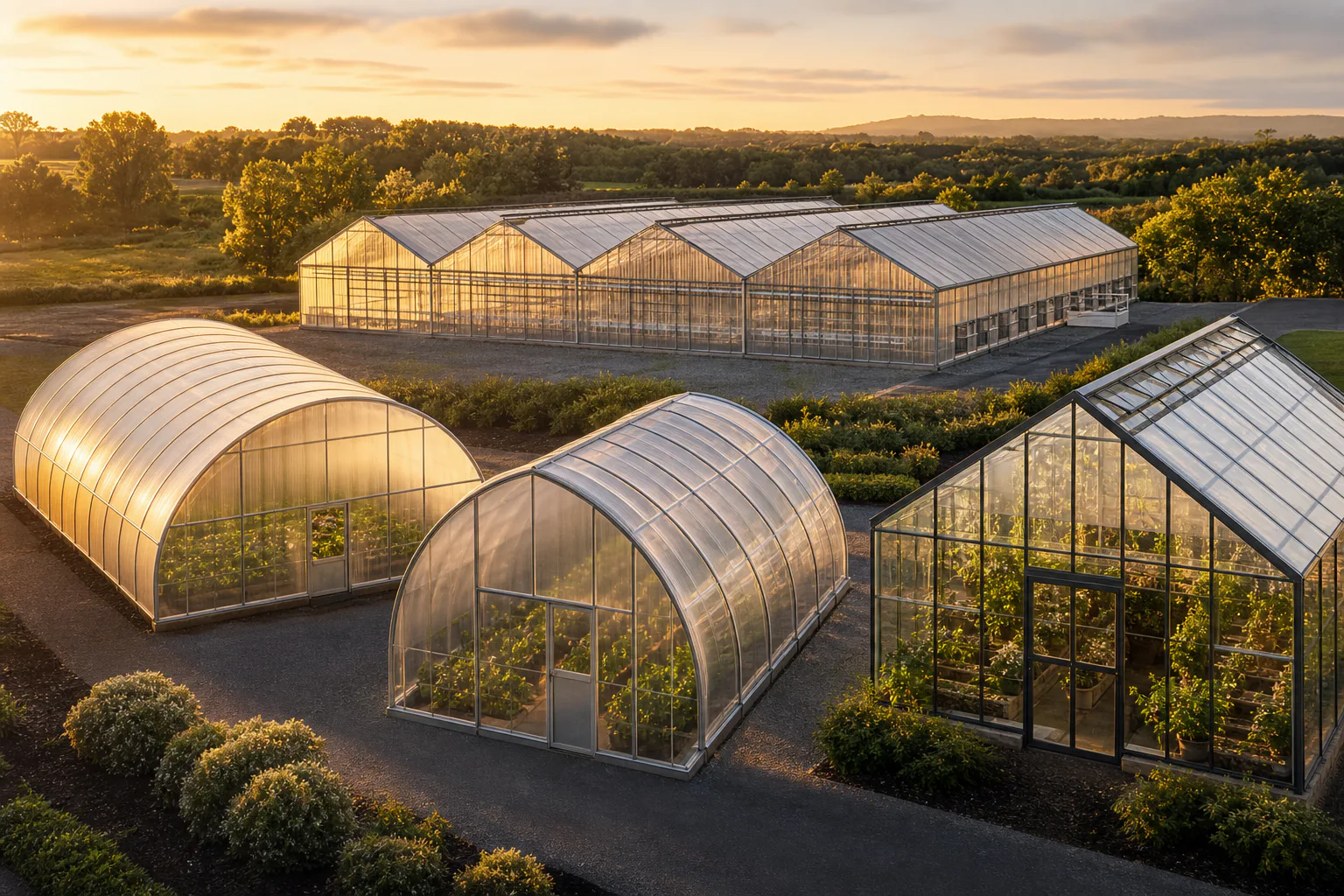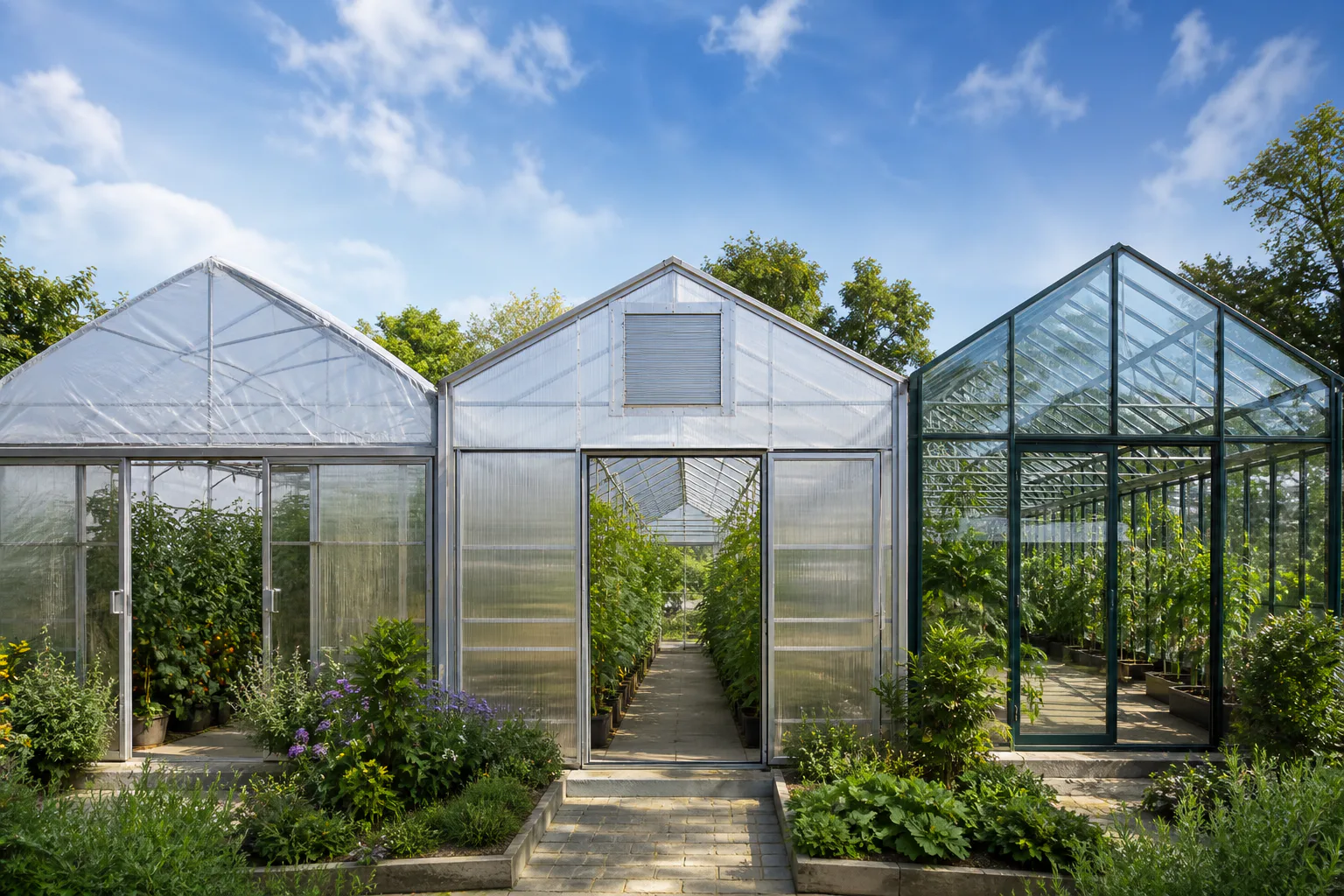
Choose a greenhouse covering by identifying the project's binding constraint: light, heating load, impact resistance, maintenance, service life, or initial capital. Polyethylene film, multiwall polycarbonate, and glass are not universally ranked. The correct covering must match the structure, climate, crop, and operating model.
Brand name or thickness alone is insufficient. Review verified product data for UV stability, anti-condensate behaviour, total and diffuse light transmission, thermal transmittance, attachment details, and warranty. For the structural context, read the greenhouse structures and coverings guide.
Quick comparison
| Criterion | Greenhouse polyethylene film | Multiwall polycarbonate | Horticultural glass |
|---|---|---|---|
| Initial capital | Usually lower | Medium to high, depending on panel construction | Usually higher with a more demanding frame |
| Weight | Very light | Lighter than glass | Heavier |
| Insulation | Single layer is weaker; inflated double layer performs better | Trapped cells improve insulation | Single glass loses more heat than multi-layer assemblies |
| Light | Good, with diffuse options available | Good but dependent on thickness, geometry, and cleanliness | High initial transmission when clean |
| Impact | Vulnerable to tearing and abrasion | Good impact resistance | More brittle |
| Maintenance | Tension, tears, and periodic replacement | Seals, channels, and thermal expansion | Cleaning, broken-pane replacement, and joint inspection |
Polyethylene film: economical but detail-sensitive
UMass high-tunnel guidance identifies 6 mil greenhouse-grade polyethylene—about 0.15 mm—as a common covering rated for roughly four to six years. This is not a universal life guarantee. UV exposure, heat at structural contact points, abrasion, chemicals, installation tension, and wind all affect service life.
In a heated greenhouse, two films separated by a low-pressure air layer can reduce night heat loss by about 40% compared with a single layer. UMass also reports measured heating savings of approximately 10–20% for infrared-retaining film, depending on sky and operating conditions. Project heat-load calculations must confirm the value.
Film options that materially affect performance
- UV stabilisation: slows premature polymer degradation.
- Anti-condensate treatment: encourages a film of water rather than crop-damaging droplets.
- Diffuse light: softens hard shadows, but total transmission should also be checked.
- Infrared retention: limits long-wave heat loss at night.
- Daytime heat control: can lower solar heat gain but may also affect useful photosynthetic light.
Polycarbonate: insulation and impact resistance with installation demands
Multiwall polycarbonate uses sealed air cells to reduce heat transfer. Performance depends on wall count, thickness, surface coating, resin quality, and installation direction. Panels need allowance for thermal movement, and channel ends must be detailed to limit moisture, dust, and biological growth.
Greater thickness or dirt can reduce light. Compare tested visible-light transmission, haze or diffusion, and U-value for the exact product. See polycarbonate greenhouse covering for the implementation route.
Glass: high initial light and long life with a demanding structure
Oklahoma State guidance describes glass as providing the highest light transmission among common greenhouse coverings. The advantage depends on clean surfaces, sound seals, and controlled structural shading. Weight, breakage, safety detailing, and frame precision generally raise initial and repair costs.
Horticultural, tempered, and diffuse glass do not have identical properties. Confirm safety classification, thickness, transmission, and installation requirements for the actual specification. See the glass greenhouse service.
More light is not always better
Light quantity and distribution should be assessed against crop, season, latitude, structural density, and shading strategy. High winter transmission may be beneficial while increasing summer cooling load. Diffuse films or glass may improve canopy distribution, but crop needs and tested manufacturer data should support the choice.
Compare whole-life cost
Price per square metre is incomplete. Compare equal operating periods and include:
- covering, connectors, and required structural support
- installation and production downtime during replacement
- heating and cooling demand
- cleaning, repairs, and spare components
- wind, hail, tear, and breakage exposure
- production effects of ageing and reduced transmission
- end-of-life removal and recycling options
A six-step selection process
- Define the crop, production season, and light requirement.
- Document radiation, temperature, wind, snow, hail, and dust exposure.
- Compare heating, ventilation, and shading loads for each assembly.
- Check structural compatibility, support spacing, and fastening method.
- Obtain the exact product data and warranty rather than relying on the material name.
- Complete a whole-life cost and repair scenario before ordering.
Common mistakes
- Comparing commodity plastic with UV-stabilised greenhouse film
- Installing polycarbonate without thermal-movement and channel-sealing details
- Assuming first-day light transmission remains unchanged
- Ignoring shadows from structure and internal equipment
- Declaring a fixed service life without warranty and site context
- Selecting glazing before wind, snow, and connection loads are resolved
Frequently asked questions
Which covering is best for a cold region?
It depends on heating load, winter light, fuel, structure, and capital. Assembly performance and sealing quality may matter more than the material label.
Will 6 mil film always last four to six years?
No. That rating applies to suitable greenhouse-grade products under appropriate use. UV, wind, abrasion, chemicals, heat, and installation change real service life.
Is polycarbonate always darker than glass?
Compare the actual product, thickness, wall geometry, coating, age, and cleanliness. A universal claim without a data sheet is unreliable.
Conclusion
The right covering emerges from four questions: what light the crop needs, what climate loads the site imposes, how the greenhouse will be heated and ventilated, and how maintenance will be performed. Compare tested assemblies and whole-life cost—not just material names and purchase prices.
Sources
Greenhouse structures and coverings
Specialist guide: choosing a cover
This guide focuses on cover selection and links to the main guide for the wider structure-and-cover comparison.
A decision table, not a price list
Compare options against the same project brief. Final selection needs the actual climate, crop, structure, and operating requirements.
| Option | Questions to resolve before selection |
|---|---|
| Greenhouse film | replacement planning, fastening detail, operating programme |
| Polycarbonate | sheet configuration, joints and sealing, insulation and light objective |
| Glass | structural design, safe installation, cleaning and maintenance access |