A greenhouse irrigation system has three jobs: supply water at the required flow and pressure, distribute it evenly, and deliver a measured volume to each crop zone. Start with the crop and growing medium, then choose the delivery method and size the hydraulic network. The same greenhouse may need different systems for propagation and production.
Choose a delivery method for each production area
| Method | Typical fit | What to verify |
|---|---|---|
| Drip lines or individual emitters | Row crops, grow bags, and containers | Emitter discharge and pressure across each zone |
| Overhead booms or sprinklers | Some plug trays and benches requiring area coverage | Distribution over the bench and the effect of wet foliage |
| Ebb-and-flow or other subirrigation | Compatible containers and benches | Drain-back, water hygiene, and salt management |
Small houses with few uniform containers may need little more than a filtered supply and one independently controlled zone. Commercial greenhouse irrigation systems often need separate zones for propagation, mature crops, and bays with different light exposure. In either case, size equipment from the operating demand of the zone rather than floor area alone.
Compare systems by production task
Drip for row crops and containers
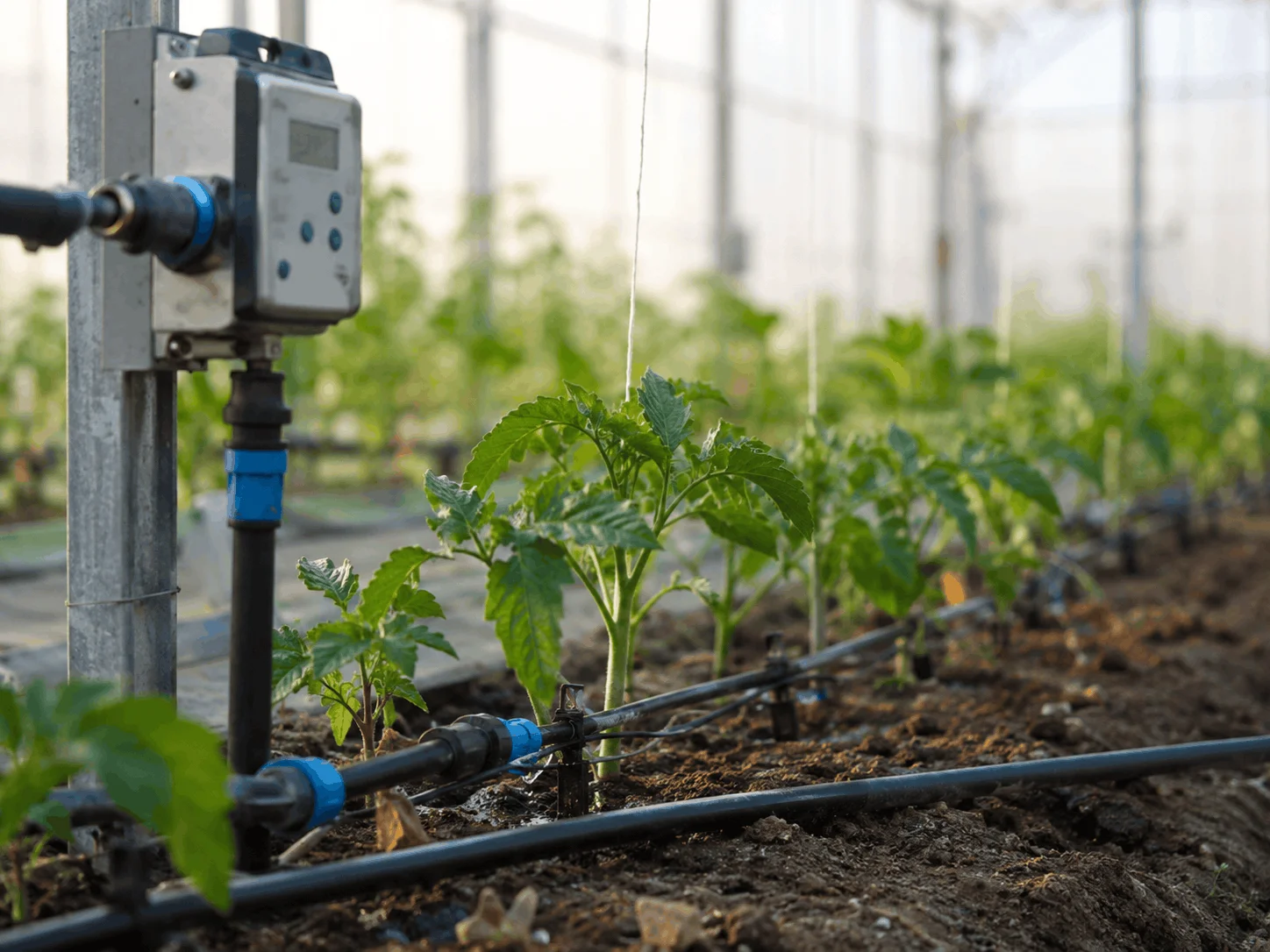
In a fruiting crop, drip puts water near the roots and allows each independently valved crop block to receive a different dose. A grow bag may have several delivery points, while a soil bed may use continuous drip tape. Inspect the wetted pattern after a known run. The emitter's rated flow is useful for design, but measuring actual output reveals plugged outlets, poor pressure at line ends, or differences between emitters.
Container size matters. A small pot with a coarse medium can drain rapidly, while a larger pot on the same bench may store enough water for a longer interval. Separate crops that need materially different schedules before buying controls. Where separation is impractical, check whether emitter sizing or rearranging the bench can correct the mismatch.
Overhead irrigation for propagation and nursery benches
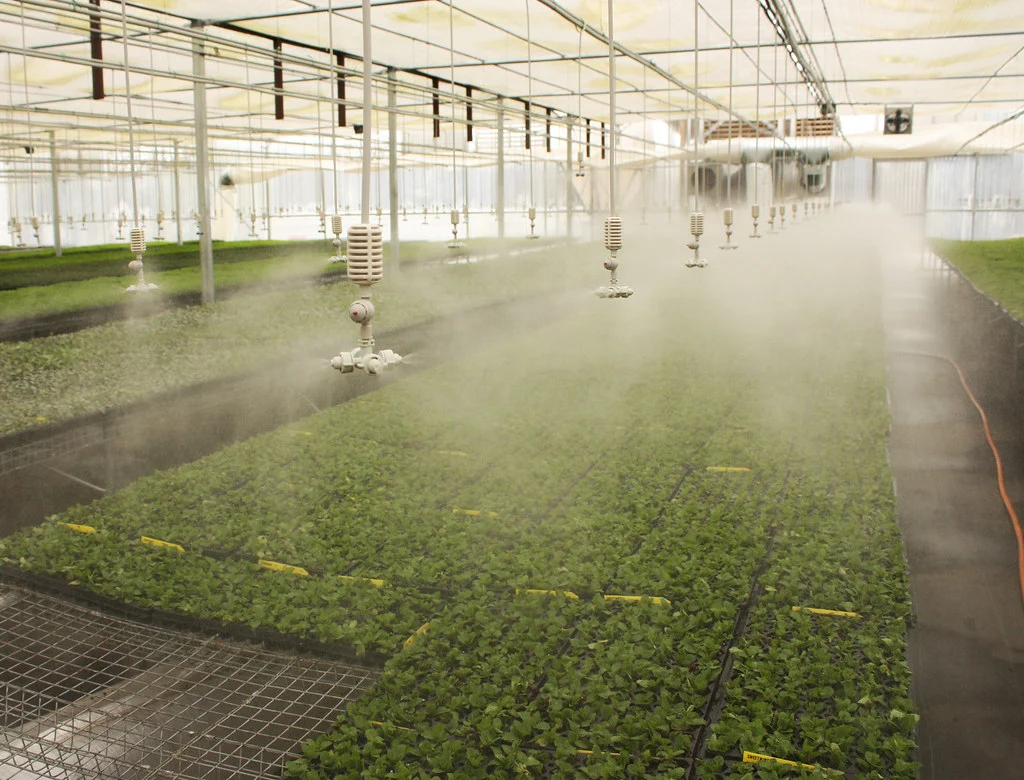
A boom or sprinkler grid can irrigate many small containers together. Assess coverage with catch containers at the centre, edges, and corners. Tray rims, crop height, spray overlap, and travel speed can change the volume that reaches the medium. Also account for how long foliage stays wet. In a mixed-use greenhouse, overhead irrigation may make sense on a propagation bench even when production rows use drip.
Misting and fogging
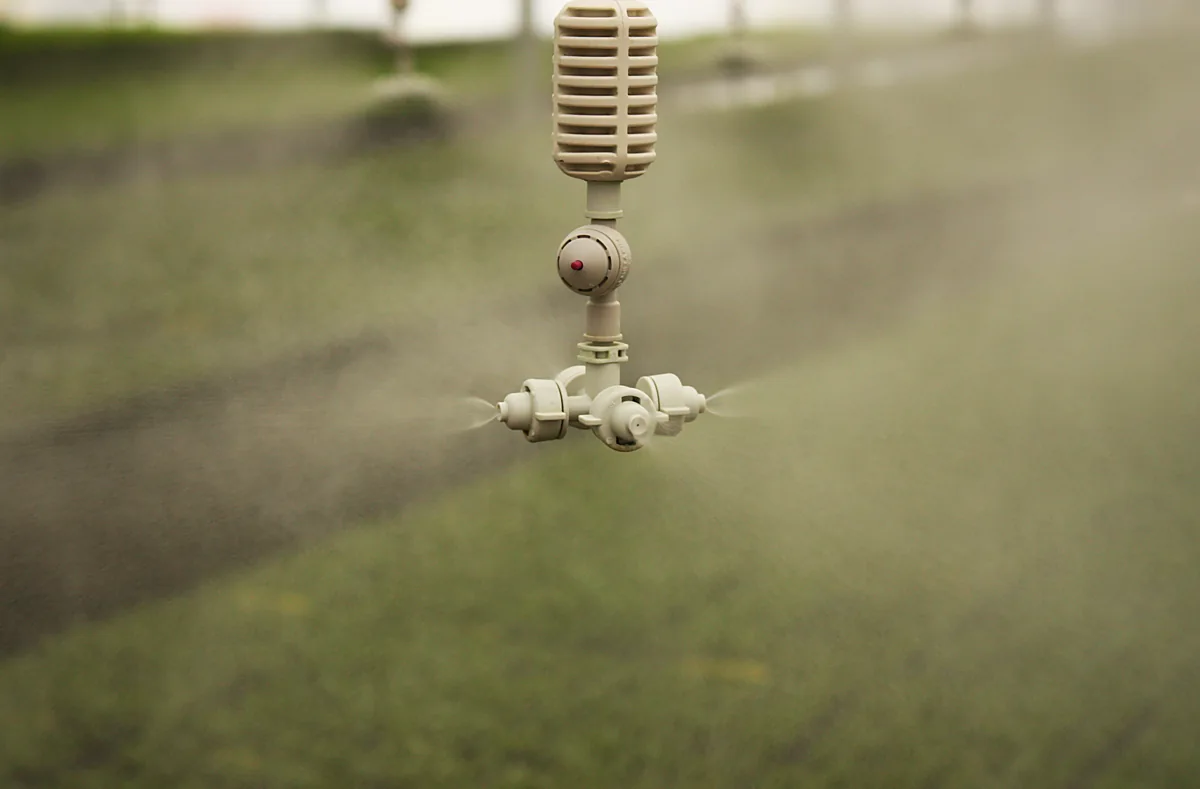
Propagation mist helps manage water loss from unrooted cuttings. Climate fogging has a different job, usually cooling or humidity control. During commissioning, verify that the crop's root medium receives sufficient water separately from any air-treatment effect. Give fine nozzles a service plan that accounts for water quality, mineral deposits, and access above the crop.
Subirrigation and recirculating nutrient solution
An ebb-and-flow bench wets containers from below, then drains back to a tank. A level bench and uniform contact help pots take up comparable amounts. Check whether the media wick water adequately and whether residual water drains as intended. A recirculating system also needs a plan for managing solids, sanitation, nutrient composition, and changes in pH or EC. Design access for sampling, cleaning, and draining the tank without disrupting unrelated bays.
Buried drip is a different approach. Water is released within a soil bed from buried outlets. If considering it, allow for flushing, pressure checks, and fault detection, since a blocked or leaking line is less visible than surface drip.
Small greenhouse versus commercial installation
For a small greenhouse, first separate what needs frequent watering from what can share a schedule. A simple single-zone kit can suit similar containers with a reliable supply. Test any gravity-fed kit at the lowest expected tank level, when the available pressure is lowest. Check whether the emitters actually deliver a usable volume at that pressure. Keep the filter and flush points reachable once the house is full of plants.
For a commercial greenhouse, define an operating scenario before requesting a proposal. List the maximum zones running together, the required flow at the highest or farthest outlet, and which operations may coincide with irrigation. A new bay, a filter cleaning cycle, or a tank refill can change system demand. Specify which failures can be isolated and how operators will water a crop if a pump or valve is unavailable.
| Design input | Small house | Commercial facility |
|---|---|---|
| Operating zones | Often grouped by bench or container type | Usually separated by bay, crop stage, or substrate |
| Water storage | Check usable tank level and refill rate | Balance peak flow, supply availability, and maintenance |
| Verification | Compare output from several emitters | Record measured pressure, flow, and distribution by zone |
| Service access | Reach filter and flush points easily | Isolate sections and document spare parts and procedures |
Check water chemistry and hydraulic performance separately
A filter catches particles selected by its rating and construction. Dissolved salts require a different assessment. Collect a representative sample from each supply and ask the laboratory or crop adviser which parameters matter for the crop and injection system. Surface storage can change over the season. When the source changes, compare the new results with the assumptions in the system design.
For the pump, compare the manufacturer’s curve with the pressure needed at the outlet plus friction, elevation, and component losses. Use the actual flow for the zones allowed to run together. Include a way to measure pressure before and after the filter. This makes it easier to distinguish filter loading from a supply or distribution problem.
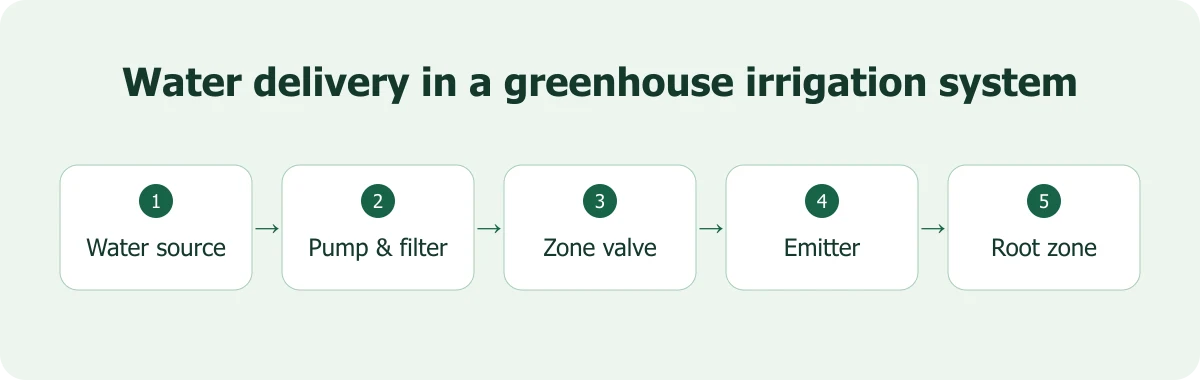
Design from the source to the root zone
- Characterize the supply. Check sustainable flow, pressure, suspended solids, salinity, and alkalinity. Use water analysis and emitter requirements to select filtration and any treatment.
- Group crops by water demand. Define which zones can run together, then add their operating flows. Allow for the pressure needed at the outlet plus losses through the network and changes in elevation.
- Specify the distribution hardware. Select pipework, valves, pressure regulators, emitters, and flushing points. Include backflow protection appropriate to the installation when injecting fertilizer.
- Plan how to measure performance. Provide pressure test points, a way to measure delivered water, and accessible drainage sampling in soilless production.
For example, 600 emitters delivering 2 L/h each require 1,200 L/h when the zone runs. A 10-minute cycle supplies about 200 L to that zone at the measured flow. Use the calculation to check equipment and volume. Determine crop run times from root-zone and drainage observations.
Schedule and commission the network
In soil beds, use moisture observations at active root depth to check how deeply each event wets the profile. In soilless crops, track delivered solution and drain volume together with EC, crop stage, and light conditions. Adjust duration and frequency separately so their effects are easier to interpret.
Before handover, measure emitter output near and far from the supply, including representative high and low points. Run all intended zone combinations. Check pressure with a clean filter, confirm flush points are accessible, and log the flow baseline for each zone. When crops receive uneven volumes, correct the hydraulic problem before increasing the run time for the entire house.
Measure distribution before adjusting the schedule
Catch the discharge from a set of emitters over the same time. Include the start and end of laterals, and sample different elevations where applicable. Divide the mean of the lowest quarter by the overall mean to describe low-quarter distribution uniformity in that sample. If the overall mean is 100 mL and the low-quarter mean is 80 mL, the ratio is 0.80. This is an illustrative measurement. Evaluate acceptance against the project specification and investigate the pattern before changing settings.
Once the system delivers water consistently, record applied volume and how the substrate responds. In container crops, use representative drain measurements to check whether a change in pulse size or interval affects the root zone. A longer cycle can increase drainage even if it supplies more water. Compare similar weather and crop stages when reviewing an adjustment.
Specify hydraulic acceptance before ordering equipment
Start at the most demanding outlet. As an illustrative calculation, an emitter requiring 100 kPa plus 40 kPa of pipe and fitting loss, 30 kPa across equipment, and about 30 kPa for a 3 m rise gives approximately 200 kPa at the supply point. The system needs that pressure at the intended operating flow. Check actual component losses, available inlet pressure, and the pump curve. Document whether the filter was clean and which valves were open during acceptance testing.
Write a separate test for each delivery method. For drip, collect emitter output over equal intervals at representative elevations and lateral positions. For a boom, measure the water caught across the bench during a normal pass. For an ebb-and-flow system, compare fill depth and drainage at several points. Use the project specification to define acceptable variation. A pass for pressure alone does not establish that the crop receives comparable water across the block.
Where to put the filter pressure gauges
Install pressure measurement upstream and downstream so the operator can distinguish loading from a loss of supply pressure. Record the clean-filter differential during operation. If the differential rises and downstream flow falls, inspect the filter at a comparable operating flow. Use the manufacturer's service criteria and give the operator a way to clean or isolate the filter without unnecessary disruption to production.
Procurement and handover
A useful quotation identifies the design flow and pressure, materials, valve schedule, filtration, fittings, installation labour, and tests included at handover. Ask the supplier to show which operating conditions support the proposed pump and emitters. For fertigation, specify who will check injection, backflow protection, and sampling points against site requirements. Price any upgrade for automatic control separately so operators can see which costs belong to the hydraulic network.
The handover should include a zone map, clean-filter pressure baseline, measured discharge, instructions for flushing, and isolation points. Run the test with the intended operating combinations. Document how to identify the first sign of a blocked filter or a zone that is receiving less water than expected.
When to add automatic control
A timer is a practical starting point when crop demand is predictable and someone can adjust it. For multiple zones or rapidly changing conditions, smart greenhouse irrigation explains how to trigger events with sensors, verify actual delivery, and handle failures.
Prepare a design brief before requesting quotes
A design brief should identify the source, its available flow and pressure, and any operating windows or supply interruptions. Include a plan of beds and benches, the elevation differences, the expected crops and container sizes, and the production areas that can share an irrigation schedule. Mark where the operator can take a sample or read a gauge. A quotation based only on greenhouse area cannot show whether the supply will meet a specific combination of zones.
Work through simultaneous demand
Consider two zones that each need 1,200 L/h. Running both requires 2,400 L/h at the design pressure. Staggering them halves the peak flow but doubles the time needed to complete the same two events. For a crop needing frequent pulses, test whether sequential operation fits the available window at peak demand before selecting the smaller pump. Also check how the system behaves when cleaning, tank filling, or a manual hose shares the supply.
If the supply replenishes storage at 800 L/h while both zones draw 2,400 L/h for half an hour, the tank loses a net 800 L during that event. To size usable storage, evaluate the full operating schedule, refill periods, and minimum usable level. The example measures drawdown during one event. It does not establish total daily storage requirements.
Plan seasonal maintenance around measured changes
Begin the season with readings for clean-filter pressure differential, supply pressure, zone flow, and representative outlets. Keep the records with the zone map. Use the same points to investigate changes during production. An increase in filter differential and a decline in downstream flow suggest checking filtration first. Normal inlet pressure with a cluster of weak outlets points toward a local issue. Readings across several zones help distinguish common supply problems from a single-zone fault.
Flush points and isolation valves should remain accessible once benches and crops are in place. Arrange a way to work on one block without shutting off unrelated areas where the layout permits. After replacing a valve, adding a bench, or changing emitter models, run the affected zone again and compare its discharge with the original baseline. Keep a list of compatible replacement parts and any limits on substitutions.
Match the layout to the crop turnover
A propagation house that rearranges trays frequently benefits from a distribution method that tolerates changing bench layouts. Test an overhead boom with the actual tray depth and spacing, including any edge positions operators regularly use. A retail greenhouse with mixed containers may benefit from grouping pots by water demand before changing hardware. A greenhouse with mature fruiting crops in fixed rows can use more permanent laterals, but the designer still needs to leave room for end flushing and cleaning between crops.
For soilless vegetable production, place drain sampling points where they can be checked throughout the season. A single container near the door may experience conditions different from the interior. Record which part of the crop the samples represent. If the design includes recirculation, plan the return route and tank access before installing benches or crop supports. Changing the return layout after planting can interrupt both irrigation and production.
Frequently asked questions
Is drip always the best greenhouse irrigation method?
Drip often suits crop rows and individual containers. A boom can serve dense propagation trays more conveniently, and subirrigation can suit compatible potted crops. Select the method by how the crop is grown and what the operator needs to measure and maintain.
Can one system serve a nursery bench and fruiting crops?
Yes, if the shared supply supports their operating flows and pressures and each area has independent distribution and scheduling. Test each zone on its own and in any combination the controller allows.
Can I install a solar-powered system?
Start with the daily water requirement, peak flow, operating pressure, and available storage. A system that can refill a tank during the day may have different requirements from one that must run a pressurized zone on demand. Check the pump’s operating point and how the crop will be supplied when solar output is low.
Sources
UMass Extension, Irrigation Systems. UF/IFAS Extension, Water and Nutrient Management Guidelines for Greenhouse Hydroponic Vegetable Production in Florida. UMass Extension, A Few Pointers for Better Irrigation.
Greenhouse irrigation and fertigation
Greenhouse irrigation design guide
Choose an irrigation method, size the network, and verify delivery before handover.
Was this article helpful?
Comments and questions
Join the conversation without an account. Names are entered by visitors; only verified staff carry the administrator badge.
Loading…