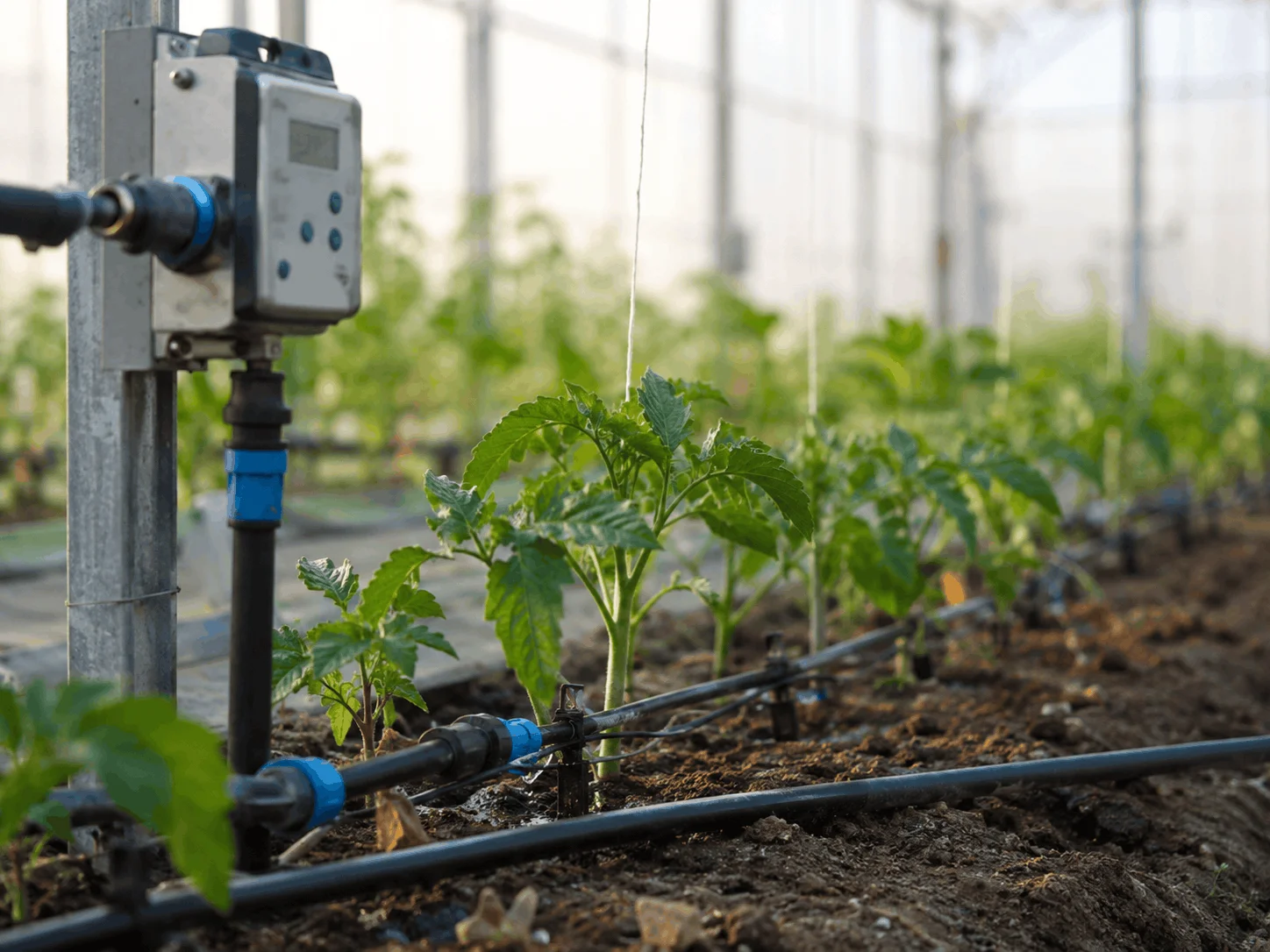
A smart greenhouse irrigation system uses crop or root-zone measurements to decide when to irrigate, then checks that the requested water was delivered. The practical upgrade from a timer is a closed loop with representative sensors, a measured flow baseline, and limits on each event. Use the greenhouse irrigation system design guide to size and test the hydraulic network before tuning the controller.
Retrofit a commercial block without changing every zone at once
Start with a representative bay where the existing hydraulic system is working well. Record the crop stage, irrigation windows, delivered volume, and drainage before enabling sensor control. Log the new controller's suggested events alongside the old schedule for a short commissioning period. Review differences with the grower before allowing unattended changes. Investigate large discrepancies first, especially when a probe calls for repeated pulses that the substrate does not seem to need.
Where one meter serves several valves, determine whether an event can be attributed to a single zone. If valves overlap, the total can look plausible even when one valve fails and another zone receives excess flow. The commissioning plan should specify when to stagger events and when separate measurement is needed.
Select the feedback signal by crop and medium
In soil beds, use a suitable moisture or tension sensor at active root depth. Cross-check the sensor with a field observation after a known irrigation event. In small-volume soilless media, consider radiation-based pulse timing alongside applied volume, drainage, and feed and drain EC. A sensor reading depends on the medium, probe placement, and contact, so validate it in the actual production setup.
Map separate control zones where crops, substrate, emitter flow, or light exposure differ. Place probes where they represent the crop rather than directly under an unusually wet emitter or in an atypical edge container. Retest after replacing media or moving emitters.
Choose triggers and safeguards separately
A trigger decides whether a crop should receive water. A safeguard decides whether the equipment can deliver water safely. For instance, a valid substrate-moisture request can initiate a cycle only if the tank level, pump state, and valve permissives allow it. After the valve opens, verify flow against the baseline. The controller should record why it rejected a request, so an operator can distinguish a dry crop from a water supply failure.
Use start and stop criteria that avoid cycling around a single noisy measurement. A moisture reading needs time to respond after a pulse. Set a minimum interval, a maximum event volume or run time, and a daily operating envelope suitable for the crop. Review these with the grower after looking at conditions on both low- and high-demand days.
Build a bounded control sequence
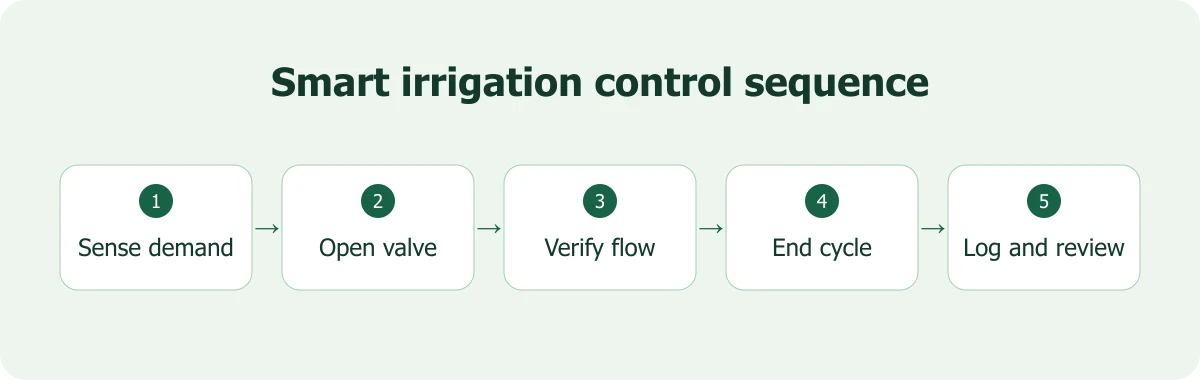
- Accept a valid irrigation request only when the zone is enabled and the supply is available.
- Open the zone valve and allow flow to stabilize. Confirm the measured flow is within that zone's commissioning range.
- Stop when the dose is delivered or the maximum run time is reached. Enforce a minimum interval before another pulse.
- Enable nutrient injection only while verified flow is present. Log the measured volume and the reason each event ended.
- If a sensor or connection fails, alert the operator and use a predefined, limited fallback if appropriate for that crop. Stop injection on loss of verified flow.
Example A: drip-fed greenhouse vegetables in substrate bags
In a high-wire crop, a controller can use accumulated radiation to vary the interval between pulses while checking a representative root-zone signal and tracking drainage. Compare feed volume, drain volume, and EC by block. If drainage rises while crop demand falls, review pulse frequency and size together with the water-holding behaviour of the medium. If drain EC climbs despite a seemingly adequate volume, confirm the readings and inspect whether solution reaches and rewets the entire bag.
A change in substrate batch, root volume, or emitter placement can make a previously useful probe position misleading. Keep a record of installation locations and cross-check them against measured input and physical observations. Avoid using a generic moisture percentage as the acceptance criterion for different media.
Example B: small greenhouse with a timed kit
A small grower may get more value from checking flow and adding one representative moisture measurement than from a full climate controller. Start by measuring a normal run and checking that far-end emitters receive comparable volumes. A sensor can prompt an operator to shorten, delay, or investigate an event. If automation is added, set limits on repeated watering and arrange a clear local override. Verify that the system remains usable during a network outage.
Diagnose faults using flow and root-zone response
| Observation | First checks |
|---|---|
| Command issued, no flow | Water supply, pump, valve response, and meter signal |
| Flow below baseline | Filter pressure drop, inlet pressure, and representative emitter discharge |
| Flow persists after shutoff | Valve closure and possible leakage |
| Normal flow, no moisture response | Probe placement, contact, and wetting pattern |
For a 1,200 L/h zone, an eight-minute event supplies 160 L at the measured flow. Comparing actual and intended volumes makes the event auditable. Assess crop response separately: a smaller dose can reduce applied water while worsening root-zone salinity or crop performance.
Translate an irrigation decision into a measurable dose
Suppose a grow bag has two emitters and each actually supplies 2 L/h under operating pressure. A three-minute pulse applies about 0.2 L per bag. If a reference group of ten bags receives 2 L in total and drains 0.4 L over the corresponding measurement window, the measured drainage fraction is 20%. Treat this as arithmetic for checking the measurement setup. Crop-specific targets depend on the medium, feed composition, climate and production stage.
When investigating a change in drainage, start with comparable samples. Check whether drainage continued after collection ended, whether the monitored bags received the intended volume, and whether the same bags were sampled in both periods. Compare the measured feed and drain EC alongside the change. If an apparent trend disappears after correcting a mismatched sample window, there is little reason to change the controller based on that trend.
Decide how the controller handles uncertainty
Log three separate states for every event: what requested irrigation, whether the system delivered it, and how the root-zone measurement responded. A flat moisture trace with verified delivery can reflect a disconnected probe, poor contact, or a wetting pattern outside the sampled zone. A high-flow alarm can point to leakage or a configuration change. Give operators the measured values, the active zone and the expected baseline so they can investigate the right problem.
A useful evaluation compares a representative trial block with a similar block under the current schedule, records crop stage and recent weather, and checks marketable yield and quality alongside applied water. Results from published cucumber or tomato trials can help choose what to measure. Local commissioning determines operating limits for the installed crop, growing medium and equipment.
Test failures before relying on alarms
| Simulated event | Expected behaviour |
|---|---|
| Probe drops out during a scheduled window | Flag the measurement as invalid and enter the documented fallback if permitted |
| Valve fails to open | Detect missing flow and prevent injection |
| Network connection is lost | Continue allowed local operation and store event records for review |
| Power returns after interruption | Verify equipment state before resuming a queued event |
Agree who receives an alert and how long the crop can tolerate interruption. Check that the operator can identify which zone needs attention, whether water was actually delivered, and what actions remain available. A fault message without the valve, time, and measured flow is harder to act on.
Commission the system on one representative zone
Record the existing schedule, applied water, drainage, and crop observations before switching control modes. Verify the sensor and metered flow during known events. Test a disconnected sensor, a failed valve, and a loss of communication, then check what the operator actually sees. Change one scheduling parameter at a time and compare like-for-like production periods before rolling out to other zones.
The 2015 greenhouse trial on tensiometer scheduling in cucumber and tomato illustrates the trade-off between water savings and yield at drier thresholds. Treat the reported thresholds as experimental conditions. Set operating values for your own crop, rooting medium, and production stage.
For help assessing an existing network, see smart irrigation design and installation. The smart greenhouse guide explains how irrigation fits with climate control and other automation.
Measure benefits against comparable production
Review water delivered per plant or production area together with marketable yield and quality. Log crop stage, outdoor light or greenhouse radiation, and management changes. A comparison across different seasons or growing stages may reflect changes in crop demand rather than the controller. If using a trial block, compare it with a similar block operating under the prior schedule and document differences between them.
Check whether the system saves operator time through fewer manual adjustments or instead creates frequent alarms that require attention. A business case can include labour, water and fertilizer use, spare parts, support, and losses from downtime. Use measured site values and document any assumptions.
Frequently asked questions
Can I use a weather forecast to control greenhouse irrigation?
A forecast can inform planning, but the greenhouse has its own light, temperature, and humidity conditions. Check local measurements and crop response before allowing an external signal to set doses automatically.
Does a flow meter replace root-zone sensors?
It answers whether water moved through a monitored pipe and how much moved. Root-zone measurements help show whether it reached a useful part of the medium. Use the two signals together where the risk and value justify it.
Should EC or pH directly trigger irrigation?
They are useful diagnostics for feed and drain management. Timing should account for crop water demand and substrate behaviour. If these measurements are used in automated fertigation, define sampling location, calibration checks, and safe responses to invalid readings.
Sources
UF/IFAS Extension, Water and Nutrient Management Guidelines for Greenhouse Hydroponic Vegetable Production in Florida. Greenhouse tomato and cucumber tensiometer study, 2015. UMass Extension, Irrigation Systems.
Greenhouse irrigation and fertigation
Specialist guide: smart irrigation
This guide focuses on controlled irrigation design and operation as a companion to the greenhouse irrigation system guide.
Design brief before choosing equipment
This short brief keeps a controller or sensor from being selected before the irrigation network and operating need are understood.
- Water source and its available quality information
- Crop zones and their operating differences
- Existing network, filtration, pumping, and electrical constraints
- The measurements and alerts that the operator can actually review
Was this article helpful?
Comments and questions
Join the conversation without an account. Names are entered by visitors; only verified staff carry the administrator badge.
Loading…