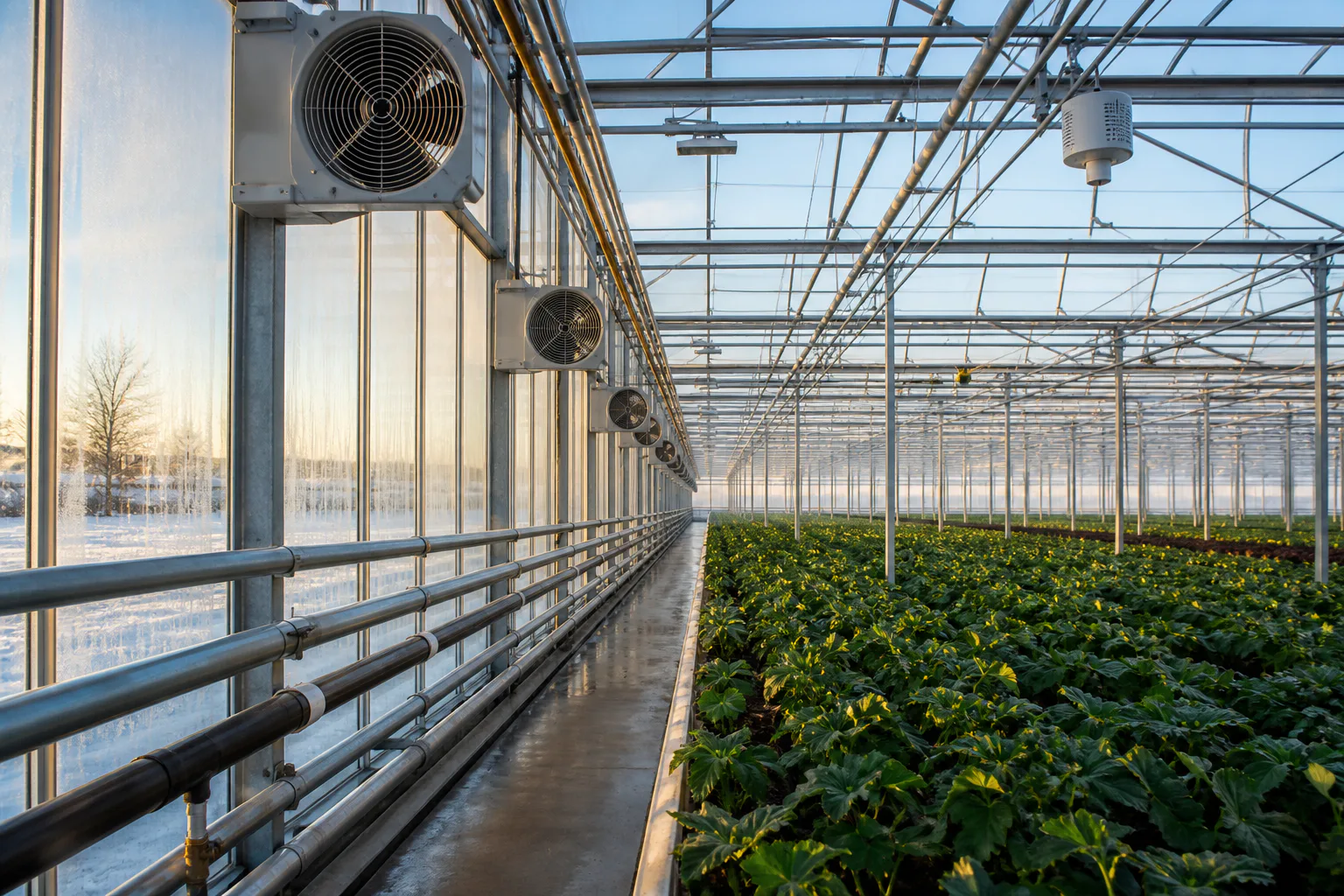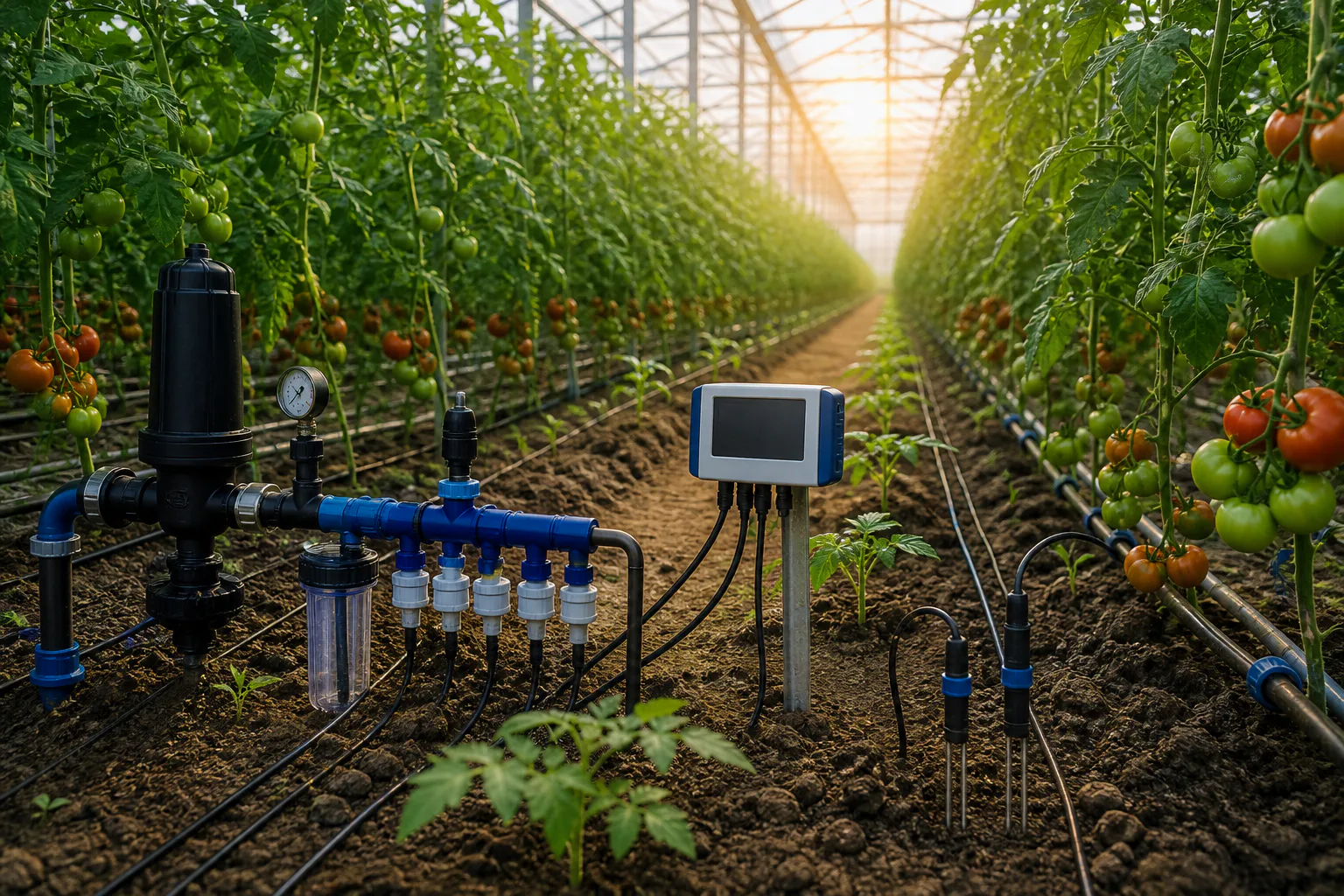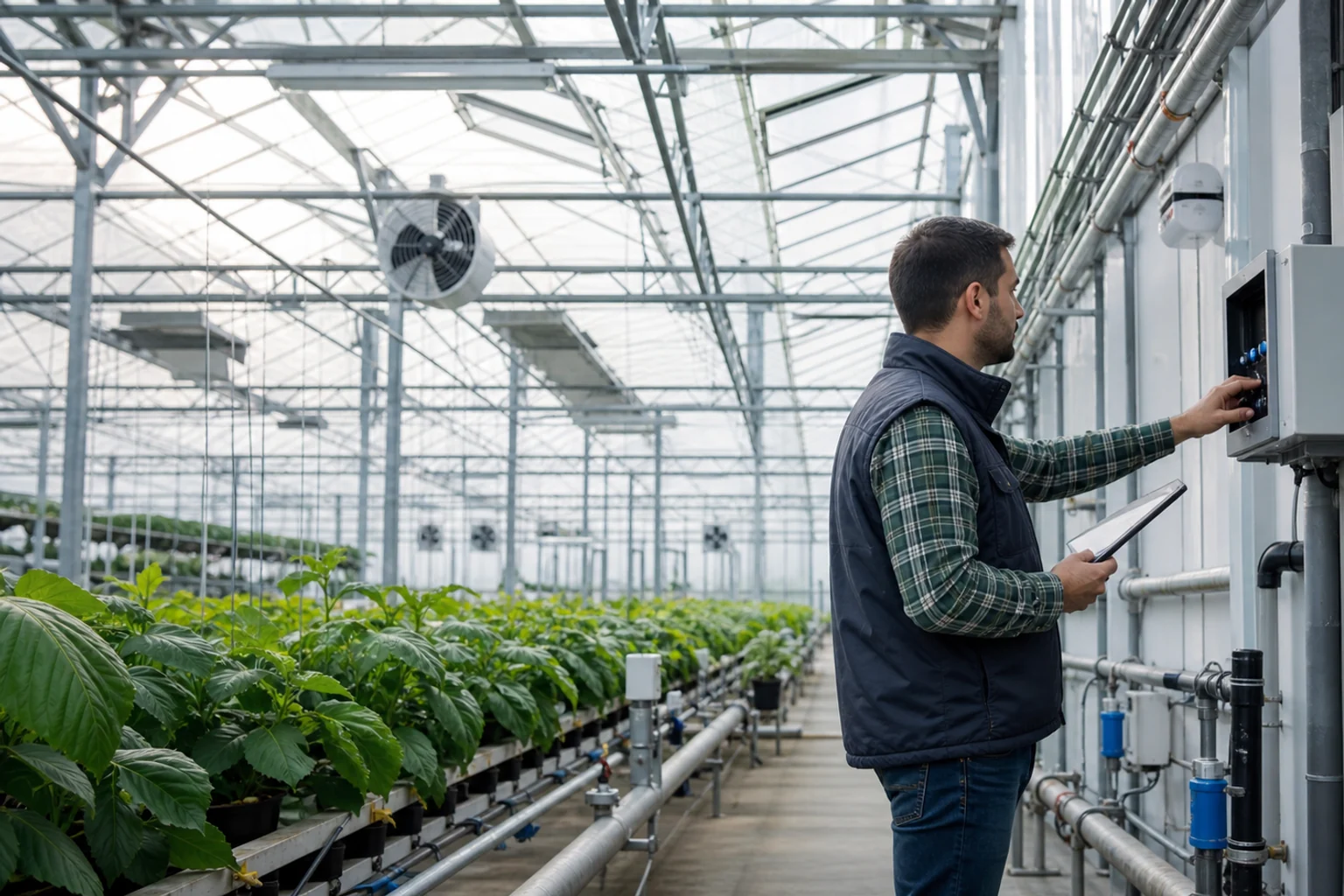
A smart greenhouse is not simply a greenhouse with sensors and a mobile dashboard. A genuinely smart system measures the growing environment, interprets those measurements, and uses predefined control logic—or more advanced algorithms—to operate irrigation, ventilation, heating, cooling, screens, fertigation and other equipment.
The objective is not automation for its own sake. The business case is more precise control: maintaining crop conditions more consistently while reducing unnecessary use of water, energy, fertilizer, labour and equipment runtime.
A 2025 review of smart greenhouse technologies identifies multisensor monitoring, intelligent control and reliable data processing as core elements of modern greenhouse management. Wageningen University & Research is also advancing autonomous greenhouse systems in which continuous crop, substrate and climate data are used to control irrigation and climate with increasingly intelligent algorithms.
What is a smart greenhouse?
A smart greenhouse is a controlled growing environment in which sensors measure conditions, a controller or software layer evaluates the data, and actuators automatically adjust the greenhouse according to crop and operational requirements.
If temperature rises beyond an acceptable range, for example, the system may stage roof vents, circulation fans or evaporative cooling rather than waiting for a worker to notice the problem. Irrigation can likewise move beyond fixed clock schedules by incorporating root-zone conditions, radiation, drainage or other crop-relevant variables.
Monitored, automated, smart and autonomous greenhouses are not the same
| Level | Typical operation | Decision model |
|---|---|---|
| Conventional | Manual inspection and switching | Grower makes and executes decisions |
| Monitored | Sensors and dashboards | System observes; operator decides |
| Automated | Timers and setpoint control | Fixed rules execute automatically |
| Smart | Integrated sensors, controls and historical data | Multiple variables influence decisions |
| Autonomous | Models, forecasting, crop feedback and advanced algorithms | A larger part of the growing strategy is generated automatically |
This distinction matters commercially. Remote temperature monitoring may be useful, but monitoring alone does not constitute full greenhouse automation.
Wageningen's autonomous greenhouse research integrates climate, irrigation, crop sensing and algorithms, while its Autonomous Greenhouse Challenge has applied automated strategies to lighting, heating, CO₂ dosing, irrigation and fertilization.
How does smart greenhouse automation work?
A robust architecture normally contains five functional layers:
- Sensing: environmental, root-zone and equipment conditions are measured.
- Communication: readings are transferred to local controllers or gateways.
- Control: the controller evaluates measurements, setpoints, rules and interlocks.
- Actuation: valves, pumps, vents, fans, heaters or other equipment respond.
- Supervision: operating data are logged, alarms are generated and performance can be reviewed.
The most important design principle is that the control loop should remain dependable even when the grower is not physically present.
Core components of a smart greenhouse
| Layer | Examples | Purpose |
|---|---|---|
| Sensors | Temperature, RH, light, CO₂, substrate moisture, EC, pH, flow and pressure | Measure actual conditions |
| Controller | PLC, climate computer or edge controller | Run control logic |
| Actuators | Valves, pumps, fans, vent motors, heaters, cooling and screens | Change conditions |
| Network | Ethernet, RS-485, Modbus, Wi-Fi or LoRaWAN | Move data and commands |
| Software | Dashboards, alarms, trend charts and setpoint management | Supervision and analysis |
| Resilience | UPS, backup power, local fallback and manual override | Protect operations during failures |
Which greenhouse sensors matter most?
Air temperature and relative humidity
These are foundational climate measurements, but placement matters. A sensor exposed to direct solar radiation, positioned immediately beside a fan or installed far from the crop may not represent the canopy environment.
Larger greenhouses can benefit from distributed sensing because the internal climate is not necessarily uniform. Recent greenhouse research has demonstrated measurable spatial and vertical differences in temperature, humidity, CO₂ and light within the same facility.
Light and radiation
Radiation information can influence screening, supplemental lighting and irrigation strategy. For crop-level decisions, photosynthetically relevant radiation measurements are generally more meaningful than a basic consumer lux sensor.
CO₂
Where CO₂ enrichment is used, measurement needs to be integrated with ventilation strategy. Injecting CO₂ while ventilation is exchanging large amounts of air can waste input unless both systems are coordinated.
Root-zone moisture
Root-zone sensing can help move irrigation away from purely clock-based operation. Sensor selection and calibration must reflect the growing medium, whether that is mineral soil, coco coir, rockwool or another substrate.
EC and pH
Electrical conductivity and pH become especially important in hydroponic and fertigation systems. Automated dosing can increase repeatability, but it does not replace a sound crop nutrition strategy.
Flow, pressure and tank level
Utility sensors often provide significant operational value. Abnormal flow or pressure can reveal blocked filters, failed pumps, leaks, closed valves or broken irrigation lines before crop symptoms become visible.
Outside weather station
External temperature, humidity, solar radiation, wind and rainfall affect ventilation, heating, cooling and screen decisions. Advanced climate control therefore considers both indoor and outdoor conditions.
Why VPD can be more useful than humidity alone
Temperature and relative humidity interact. Vapour pressure deficit, or VPD, provides a more integrated description of atmospheric drying demand and is widely useful when evaluating transpiration and greenhouse humidity conditions.
There is no universal VPD target for every greenhouse. Crop type, growth stage, radiation and management objectives all influence the appropriate operating range.
What can greenhouse automation control?
- Irrigation zones
- Water and nutrient pumps
- Fertigation and dosing
- Ventilation fans
- Roof and side vents
- Pad-and-fan cooling
- Fogging systems
- Heating systems
- Shade screens
- Energy curtains
- Supplemental lighting
- CO₂ dosing where applicable
- Air circulation
- Water storage and transfer equipment
The real value lies in coordination. Automation that allows heating and cooling equipment to work against each other can increase costs rather than reduce them.
How can a smart greenhouse reduce operating costs?
1. More precise irrigation
Sensor-informed irrigation can better align watering with root-zone and environmental conditions. FAO has documented practical low-cost IoT greenhouse systems that monitor temperature, humidity, soil moisture and light while allowing farmers to manage drip irrigation and receive real-time alerts.
2. Better nutrient control
Automating dosing, EC and pH management can improve consistency and reduce unnecessary input. In advanced soilless production, drainage monitoring and recirculation can further improve resource efficiency.
Current Wageningen research into autonomous fertigation integrates root-zone moisture, EC, pH, temperature and additional measurements with irrigation and nutrient control.
3. Lower avoidable energy use
Heating, cooling and ventilation equipment can be operated closer to actual demand rather than running for unnecessarily long periods. Predictive control can go further by anticipating environmental changes instead of reacting after a threshold has already been exceeded.
Published studies have reported substantial water and energy improvements from specific advanced control strategies. These figures are highly dependent on greenhouse type, baseline control, climate and experimental conditions and should not be treated as guaranteed savings for a commercial project.
4. Less repetitive manual intervention
Opening valves, switching pumps, checking temperatures and carrying out repetitive equipment adjustments can be automated. Labour is not eliminated; it shifts toward crop management, maintenance and exception handling.
5. Faster detection of failures
A pump failure, abnormal temperature, empty storage tank or power event can occur between manual inspections. Immediate alarms improve response time and may prevent a minor equipment problem from becoming a crop-loss event.
6. Better operational data
Historical records make it possible to compare energy use, irrigation behaviour, equipment runtime and crop performance across production periods. That creates a basis for continuous optimization rather than management by intuition alone.
Does automation always reduce costs by a fixed percentage?
No credible universal percentage exists.
A poorly controlled greenhouse may have substantial avoidable consumption and therefore a large savings opportunity. A facility that is already well managed may obtain a much smaller direct reduction from additional automation.
The correct approach is to establish a baseline for water, energy, fertilizer, labour and crop losses before implementation and measure the same indicators afterward.
Why resilience is especially important for greenhouse automation in Iran
For Iranian growers, energy availability can be as important as energy price. Agricultural reports published during 1405 have described emergency fuel arrangements intended to maintain greenhouse production during potential gas or electricity disruptions.
This makes an offline-capable control architecture particularly valuable. Critical irrigation, ventilation and equipment-protection logic should not depend solely on access to a remote cloud server.
A 2026 study of the AgroNova platform demonstrated a hybrid architecture in which gateway-level autonomous control continued operating during temporary internet disruptions.
Should a smart greenhouse work without internet access?
Yes, for critical functions. Internet connectivity is useful for remote access, cloud storage and advanced analytics, but loss of connectivity should not disable basic crop-protection controls.
A resilient architecture typically includes:
- Local sensors and actuators
- A local PLC or edge controller
- An internal communications network
- Cloud services for reporting and advanced analytics
- Fail-safe states
- Manual emergency control
Three practical levels of greenhouse automation
Level 1: Monitoring and alarms
This may include temperature, humidity, tank level, power status, substrate moisture, trend charts and mobile alerts. It is often the lowest-risk first step for an existing facility.
Level 2: Operational automation
Irrigation, pumps, fans, vents, cooling, heating and screens are connected to local control logic. For many commercial growers, this level can deliver much of the practical value without requiring complex artificial intelligence.
Level 3: Data-driven and predictive control
Historical data, multisensor feedback, weather forecasts, crop models or machine-learning algorithms influence control strategies. Research greenhouse systems are increasingly moving toward this level of autonomy.
How much does greenhouse automation cost?
There is no meaningful universal price per square metre for smart-greenhouse automation.
Cost depends on:
- Total greenhouse area
- Number of independently controlled zones
- Number and grade of sensors
- Existing electrical infrastructure
- Number of pumps, valves and motors
- Whether vents and screens are already motorized
- Fertigation complexity
- Controller architecture
- Networking requirements
- Software and cloud services
- Backup power requirements
- Installation and commissioning
- Calibration and maintenance
A small multi-zone hydroponic facility with precise fertigation may therefore require more automation hardware than a physically larger but operationally simple greenhouse.
How to calculate the investment
Automation CAPEX = sensors + controllers + electrical panels + actuators + networking + software + installation + resilience infrastructure
Then evaluate total ownership cost:
Total ownership cost = initial CAPEX + calibration + maintenance + replacement parts + software/connectivity + repairs
For financial assessment:
Annual net benefit = water savings + energy savings + fertilizer savings + labour savings + avoided losses + additional crop value − system operating costs
Simple payback = automation investment ÷ sustainable annual net benefit
Marketing claims should not be used as substitutes for measured baseline consumption.
What should you automate first?
| Main problem | Likely first priority |
|---|---|
| Irrigation inconsistency | Root-zone sensing, flow measurement, zoning and irrigation control |
| High energy cost | Energy logging, heating, ventilation and screen coordination |
| Temperature instability | Distributed sensing and staged ventilation/cooling control |
| Nutrient inconsistency | EC, pH and fertigation automation |
| Repetitive labour | Valve, pump, vent and routine equipment control |
| Unexpected failures | Alarms, flow/pressure monitoring, backup power and fail-safe logic |
Starting from the largest measurable production problem is usually more effective than purchasing a generic “smart greenhouse package.”
Can an existing greenhouse be retrofitted?
Yes. Retrofit projects can often be implemented in stages:
- Inventory existing equipment.
- Identify high-cost or high-risk processes.
- Install baseline sensing and logging.
- Define control zones.
- Connect suitable equipment to local controls.
- Automate one process at a time.
- Measure results and refine setpoints.
Older fans, pumps, vents or electrical systems may require mechanical or electrical upgrades before they can be integrated safely.
Why simple setpoints are not enough
Industrial control relies on more than a single on/off threshold. Important concepts include hysteresis, delays, interlocks and equipment priorities.
- Hysteresis prevents rapid switching around a threshold.
- Delay logic prevents unnecessary short-cycle operation.
- Interlocks prevent incompatible or unsafe actions.
- Priority logic resolves situations where multiple control objectives compete.
This is one of the key differences between a connected hobby system and dependable commercial greenhouse automation.
Where does artificial intelligence fit?
AI can support climate forecasting, image analysis, anomaly detection, dynamic setpoint optimization and multi-objective resource management.
It should sit on top of reliable instrumentation rather than replace it. A sophisticated model receiving incorrect sensor data can produce sophisticated but incorrect decisions.
Recent autonomous-greenhouse research likewise emphasizes that intelligent control depends on appropriate sensors, reliable measurements and accurate crop-response models.
Does every greenhouse need AI?
No. Many operations gain more immediate value from well-engineered rule-based control.
If irrigation is still switched manually or a worker must physically activate ventilation when temperature rises, advanced machine learning is unlikely to be the first investment priority.
AI becomes more relevant when sufficient quality data exist, multiple variables interact, the energy bill is substantial, decisions are multi-objective and foundational automation is already reliable.
Cybersecurity and operational safety
Connecting greenhouse equipment to networks creates additional operational risk. Practical safeguards include:
- Avoiding direct uncontrolled internet exposure of PLCs
- Individual user accounts
- Strong authentication
- Controlled remote access
- Configuration backups
- Logging significant control changes
- Segmentation of critical control networks where appropriate
- Managed software updates
- Manual emergency operation
Sensor calibration is not optional
A visually impressive dashboard is useless if its measurements are wrong. Temperature, humidity, EC, pH and other sensors require appropriate verification and calibration procedures.
Recent smart-greenhouse literature specifically identifies sensor calibration, long-term stability and interoperability as practical challenges for multisensor systems.
Seven common smart-greenhouse mistakes
- Buying sensors before defining the problem.
- Making critical control fully cloud-dependent.
- Using unsuitable non-industrial hardware in harsh locations.
- Ignoring sensor calibration.
- Providing no manual override.
- Starting with AI before reliable automation and data logging exist.
- Failing to calculate measurable return on investment.
Smart greenhouse implementation checklist
- Sensors are appropriate for the intended measurement.
- Sensor placement represents the crop environment.
- Historical data are recorded.
- Critical alarms reach the responsible operator.
- Basic control remains operational without internet access.
- Manual override is available.
- Power failure and restart behaviour are defined.
- Sensor failure cannot trigger unsafe equipment behaviour.
- Crop-specific setpoints can be adjusted.
- User permissions are controlled.
- Resource consumption can be measured.
- Calibration and maintenance schedules exist.
How do you know whether the automation investment worked?
Do not measure success by the number of installed sensors. Compare operational KPIs before and after implementation:
- Water use per kilogram of saleable crop
- Energy use per square metre or kilogram
- Fertilizer input relative to saleable output
- Labour hours spent on automatable tasks
- Frequency and duration of climate excursions
- Waste and downgraded crop
- Undetected equipment failures
- Maintenance and downtime
- Yield and marketable quality
Frequently asked questions
Can a smart greenhouse operate without internet access?
Critical functions should be able to. A local controller can continue irrigation, climate and safety logic while internet connectivity is used for remote supervision and additional services.
What is the most important greenhouse sensor?
There is no single answer. Temperature and humidity are foundational, but hydroponic systems may also require EC and pH, irrigation optimization may require root-zone and flow measurements, and advanced climate control may benefit from radiation, CO₂ and outside weather data.
Does greenhouse automation reduce labour?
It can reduce repetitive manual tasks and the need for continuous on-site equipment switching. It does not eliminate the need for crop management, maintenance, harvesting and skilled technical oversight.
Can an old greenhouse be converted into a smart greenhouse?
Yes. Monitoring can be added first, followed by staged integration of irrigation, ventilation, heating and other equipment where the economic case is strongest.
Does a small greenhouse need artificial intelligence?
Usually not as a first step. Reliable alarms, irrigation automation and basic environmental control can produce more practical value before advanced predictive systems are considered.
How much does smart greenhouse automation cost?
The cost cannot be determined reliably from area alone. Zones, sensors, actuator count, fertigation requirements, existing equipment, electrical work, software, connectivity and resilience requirements all materially affect the project.
Where does automation usually save the most money?
That depends on the existing operation. The largest opportunity may be irrigation, fertilizer, heating, cooling, labour or avoided crop losses. Measuring current resource use is the only reliable way to establish the priority.
Conclusion: a smart greenhouse is about better control, not more gadgets
The strongest automation projects begin with an operational problem rather than a shopping list.
One greenhouse may need better irrigation control; another may be losing money through excessive heating, unstable climate, equipment failures or inconsistent nutrient management. Sensors and automation should be selected to solve those specific problems.
A practical maturity path is measurement → data logging → alarms → automatic control → optimization → predictive control. Skipping the foundations and moving directly to a complex AI platform does not automatically produce a smarter greenhouse.
In 1405, particularly where water efficiency, energy management and production continuity are commercially important, the real value of a smart greenhouse is its ability to make the state of the crop and equipment visible, react consistently and use resources only when and where they are needed.
Smart greenhouse and automation
Comprehensive smart-greenhouse guide
This page brings smart-greenhouse decisions together from fundamentals to subsystem selection, with deeper specialist guides below.