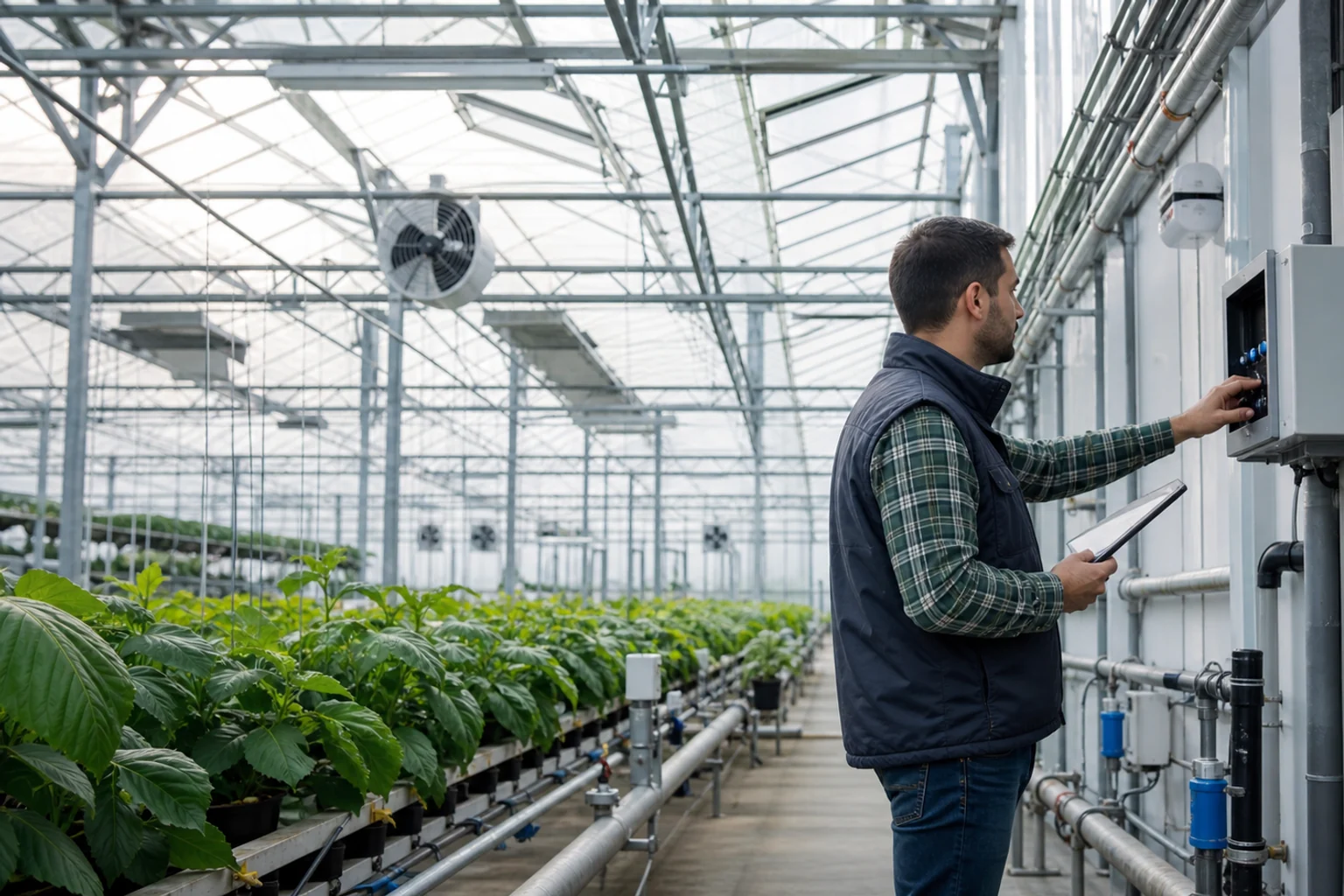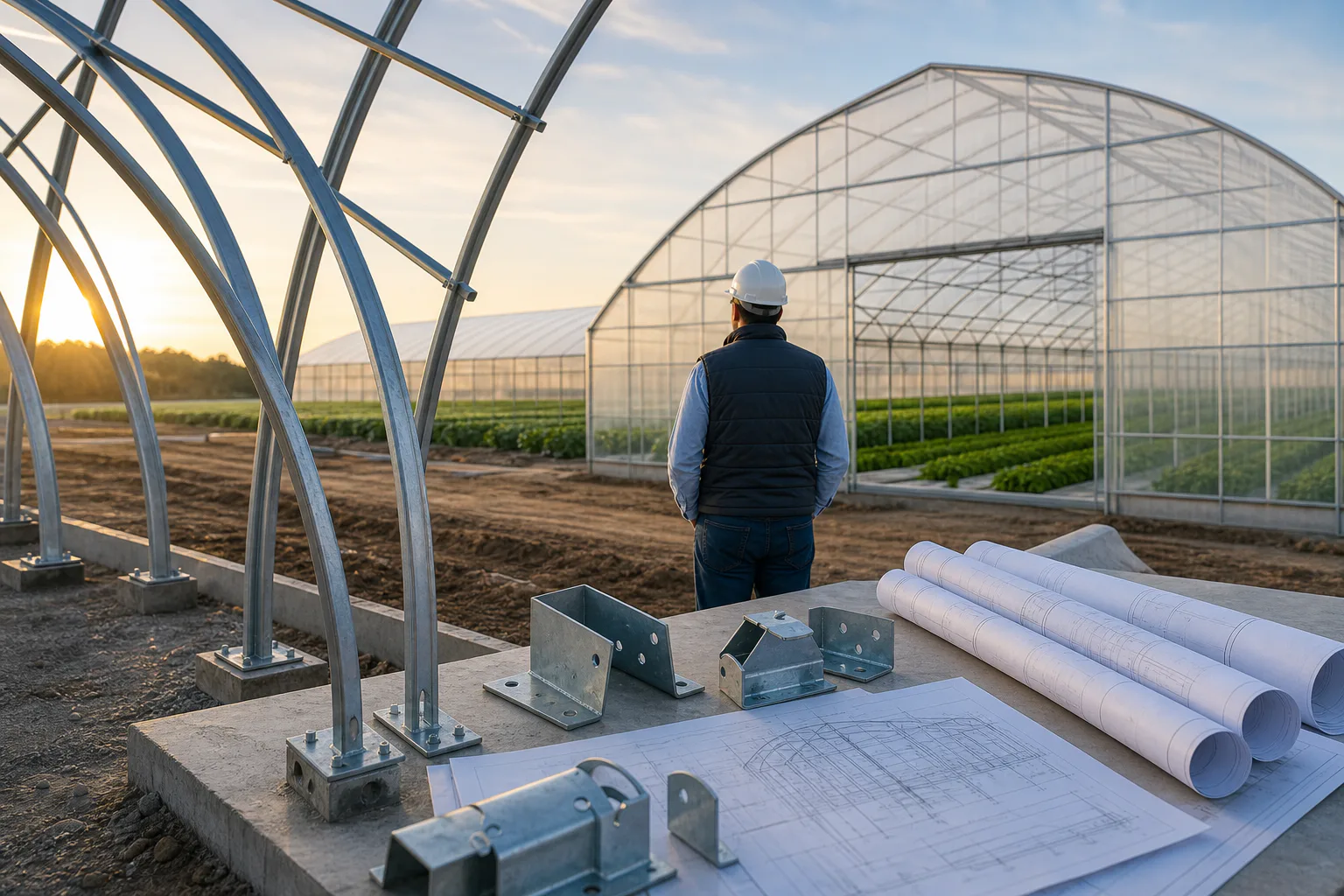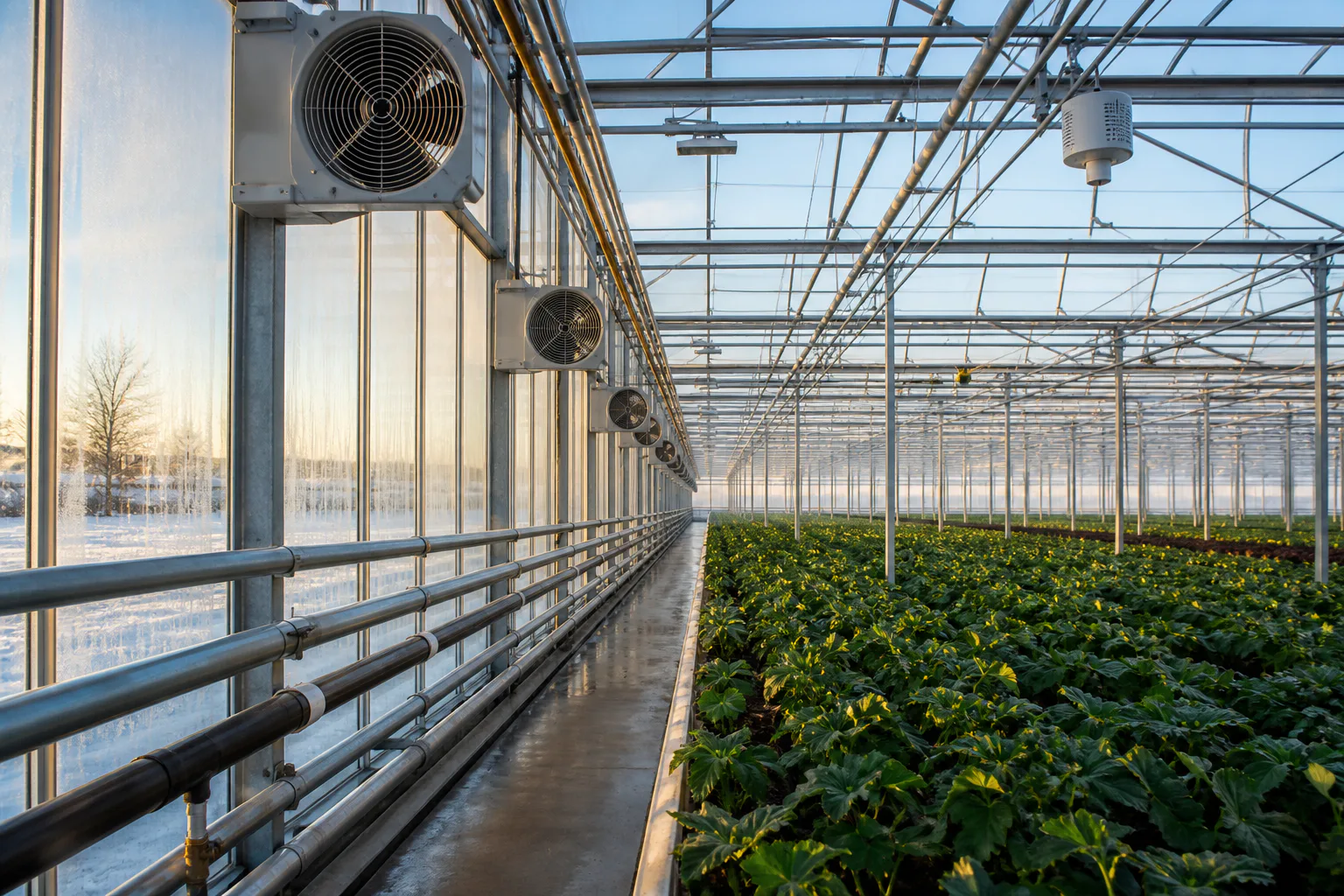
Cold-season greenhouse climate control means protecting the crop without sacrificing humidity control simply to hold air temperature. If the house is sealed too tightly, crop transpiration condenses on the coldest surfaces. If ventilation is unmanaged, valuable heat is lost. Heating, internal air circulation, minimum ventilation, dew-point monitoring, and the greenhouse envelope must therefore operate as one system.
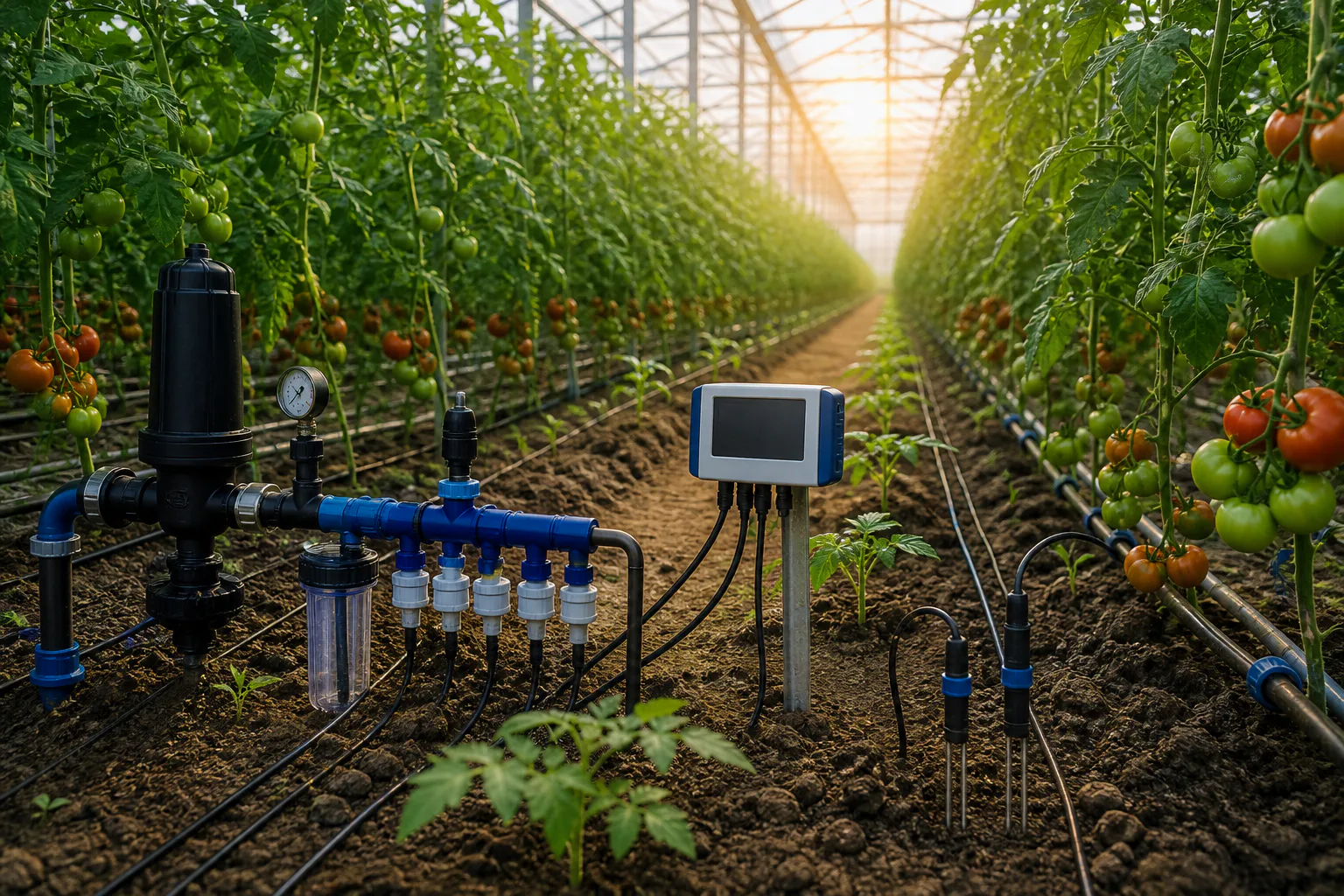
There is no single temperature or relative-humidity setpoint for every crop. Cultivar, growth stage, radiation, canopy density, and disease risk all matter. The smart greenhouse architecture guide explains how these sensors and actuators connect.
Why air temperature alone is insufficient
Condensation begins when a leaf or glazing surface reaches the dew point of the surrounding air. A centrally mounted sensor may report an acceptable value while leaves beside the sidewall remain colder. Air temperature, relative humidity, and the temperature of vulnerable surfaces must be interpreted together.
Cornell greenhouse engineering guidance describes a basic cold-weather humidity strategy: introduce some outside air, heat it so it can absorb moisture, then exhaust the moist air. Horizontal air flow reduces stagnant layers, temperature stratification, and persistent leaf wetness.
Understanding the heat balance
In simplified terms, conductive heat load increases with envelope area, heat-transfer coefficient, and the indoor-outdoor temperature difference. Air leakage adds another load. Upsizing a heater without repairing leakage, distribution, and glazing may only increase fuel use.
| Problem | Field symptom | First check |
|---|---|---|
| Air leakage | Local cold drafts and long burner cycles | Doors, vents, glazing joints, and idle fan shutters |
| Single glazing | Cold internal surfaces and more condensation | Suitability of double glazing or another insulation measure |
| Poor heat distribution | Temperature difference along the house | Hydronic balance, heater placement, and horizontal air flow |
| Late ventilation | Humidity spikes and glazing drip | Short, controlled ventilation before dew-point risk rises |
| Bad sensor placement | Stable reading that disagrees with the crop | Calibration and canopy-height relocation |
Energy measures with traceable figures
UMass reports that an inflated double layer of polyethylene can reduce night heat loss by about 40% compared with a single layer. The same source gives a 20–50% potential saving for well-installed thermal blankets or curtains. These are not guaranteed bill reductions: seal quality, glazing area, local climate, and heating hours affect actual savings.
Penn State estimates that correcting accessible greenhouse air leaks can often reduce heating costs by roughly 5–10%. Measuring and repairing the envelope is usually a lower-risk first step than buying larger heating equipment.
Sensor placement
- Place temperature and humidity sensors near canopy height, away from direct solar radiation, heaters, doors, and foggers.
- Do not assume one central sensor represents a long or multi-bay house.
- Use a radiation shield and gentle aspiration where sensor heating can bias the reading.
- Keep a calibrated reference instrument for periodic checks.
- Store trends; a single live value rarely reveals the cause of instability.
A cold-night control sequence
- Before sunset, verify heating, pumps, circulation fans, fuel, and backup power.
- Close the energy curtain according to radiation and design logic rather than clock time alone.
- Distribute heat uniformly through the crop zone.
- Use horizontal air flow to limit stagnant cold pockets.
- When humidity approaches a risk threshold, use short heated-ventilation cycles to remove moisture.
- Keep low-temperature, sensor-failure, and power-loss alarms independent of the public internet connection.
Ventilation is not circulation
Circulation fans mix air inside the house; they do not remove water vapour. Ventilation replaces moist internal air with outside air and directly affects heating load. A sound design sizes and controls these two functions separately.
Selecting a heating approach
Unit heaters, hydronic pipes, root-zone heating, or a combination may be appropriate. Compare them using the measured heat load, available fuel, required uniformity, installation space, maintenance, combustion safety, and backup strategy. See greenhouse heating and ventilation systems for the implementation path.
Common cold-season mistakes
- Closing every vent to retain heat
- Mounting the climate sensor over a heater or in direct sunlight
- Treating circulation fans as a substitute for fresh-air exchange
- Closing a thermal curtain without managing moisture below it
- Using conflicting setpoints that demand heating and exhaust simultaneously
- Having no local alarm or backup supply for critical equipment
Commissioning checklist
- Measure temperature variation across the house on a real cold night.
- Log temperature and humidity at canopy height and near the coldest zone.
- Have combustion equipment, flues, and heat exchangers inspected by a qualified person.
- Manually test every vent and fan.
- Test power-loss and low-temperature alarms.
- Review interlocks so heating and exhaust do not run against each other without purpose.
Frequently asked questions
Is there one safe humidity setpoint for all crops?
No. Crop sensitivity and growth stage matter, and dew point depends on both moisture content and surface temperature.
Will double polyethylene always cut the bill by 40%?
No. The UMass figure refers to night heat-loss reduction under the described configuration. Cost savings depend on climate, sealing, fuel, and operating hours.
What does automation improve?
It makes sequencing, trend logging, fault detection, and setpoint coordination more consistent. It does not replace heat-load design or maintenance. See greenhouse automation and control.
Conclusion
A thermostat cannot manage winter climate by itself. Improve the envelope first, distribute heat evenly, and control moisture using dew point and deliberate ventilation. A successful system protects the crop and preserves a traceable reason for each command and alarm.
Sources
Smart greenhouse and automation
Specialist guide: cold-season climate management
This guide connects heating, humidity, and ventilation management in cold weather to monitoring and automation.
Cold-weather operating check
This is a decision checklist, not a substitute for crop-specific setpoints or project calculations.
- 1Check the cover, openings, and sealing before the cold period.
- 2Confirm the measurement point represents the crop zone, not the heater or an exterior opening.
- 3Define who receives and responds to an alert.
- 4Review heating, air movement, ventilation, and irrigation together after each meaningful setting change.