Smart greenhouse irrigation means applying the right volume of water and nutrients at the right time and in the active root zone, using measured feedback rather than guesswork. It can reduce water use and moisture swings, but there is no universal savings percentage. Crop, growth stage, climate, substrate, water quality, emitter uniformity, and control logic determine the result.
A digital timer alone is not a smart system. A dependable installation measures actual conditions, executes a command, verifies the outcome through flow or moisture response, and raises an alarm when something fails. The wider system context is covered in the smart greenhouse guide.
What problem does smart irrigation solve?
A fixed schedule may run unchanged on cloudy and sunny days, at transplanting and during heavy fruit load. This can cause overwatering, water stress, nutrient leaching, or salt accumulation. Feedback control adjusts irrigation using root-zone water status, radiation, temperature, flow, applied volume, and drainage where those measurements are available.
FAO guidance reports overall irrigation efficiency below 40% for surface irrigation, roughly 60–85% for sprinkler systems, and up to about 90–95% for well-designed and correctly operated microirrigation. These figures describe technical potential, not a guaranteed result for an individual greenhouse.
A transparent water-saving calculation
FAO gives a useful efficiency example. To deliver a net crop requirement of 100 m³, a system operating at 70% efficiency needs about 142.9 m³ of gross input. At 90% efficiency it needs 111.1 m³. The 31.8 m³ difference is approximately a 22% reduction from the original input. The saving comes from reducing avoidable losses; it does not mean the crop's physiological requirement has been cut.
The correct objective is not the lowest irrigation volume. It is the lowest avoidable loss that still protects root health, yield, and quality.
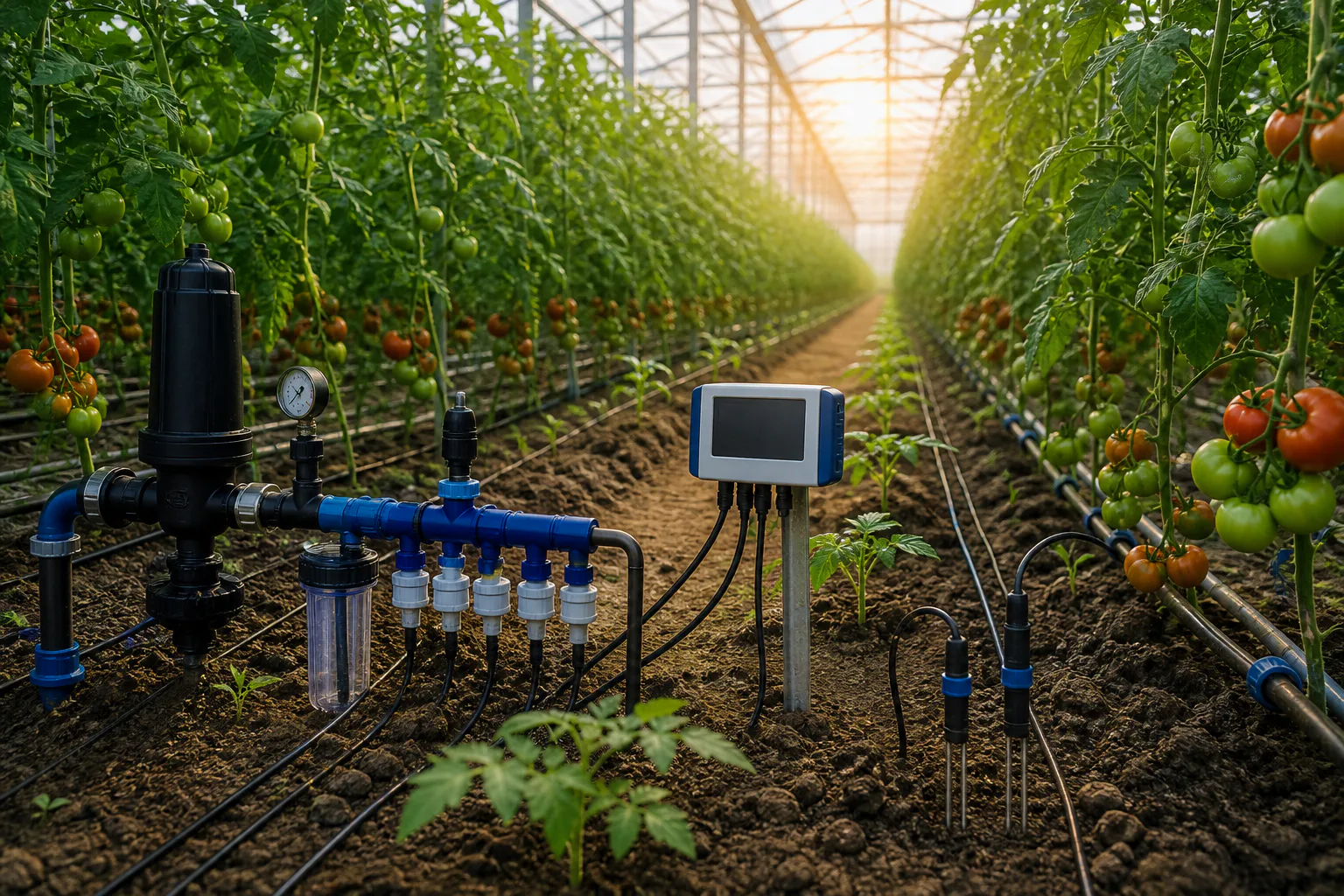
Essential system components
| Component | Purpose | Evidence of correct design |
|---|---|---|
| Source and pump | Provide flow and pressure | Stable pressure at near and remote laterals |
| Filtration | Protect emitters | Filter type matches the actual water contaminants |
| Valves and zones | Separate management areas | Different crops, ages, or substrates can be controlled independently |
| Emitters and pipework | Distribute water | Measured discharge and distribution uniformity |
| Sensors | Measure root-zone or climate conditions | Representative position and documented calibration |
| Flow meter | Verify execution | Leaks, blockages, and failed valves can be detected |
| Controller and alarms | Run logic and record events | Safe manual mode, alarm history, and bounded commands |
| Fertigation unit | Apply nutrients safely | EC and pH checks align with the crop programme |
Sensor placement and calibration
A sensor should represent root behaviour, not the easiest cable route. A probe very close to an emitter may remain wet while the edge of the wetted volume becomes dry. Depth, distance from the outlet, number of probes, and zone definition should reflect rooting and hydraulic variation.
- Define at least one representative measurement area for each management zone.
- Cross-check readings against physical substrate observations, weight, or a reference method.
- Treat initial start and stop thresholds as commissioning values, then refine them using crop and drainage response.
- Alarm on failed probes, broken cables, and readings outside plausible bounds.
What field research actually shows
A 2015 greenhouse study used tensiometer-controlled irrigation thresholds for tomato and cucumber. The drier threshold saved an average of 35% of water for tomato and 46% for cucumber across two cycles. In the second cycle, however, tomato yield under the drier treatment fell by 40%. Copying the threshold would therefore be the wrong lesson; season, crop, and growth stage decide whether a saving remains agronomically acceptable.
A 2024 greenhouse tomato study reported irrigation-rate reductions of 24.3–63.8% for two intelligent fertigation treatments compared with the farmer treatment under its experimental conditions. The treatment maintaining soil moisture at 80–85% of field capacity produced the best reported balance. The wide range demonstrates why savings must always be stated against a defined baseline.
A practical control sequence
- Define crop, stage, root volume, substrate, and water-quality requirements.
- Measure baseline flow, run time, delivered volume, and drainage by zone.
- Combine a feedback threshold with safe time and volume limits.
- Verify each command using measured flow.
- Review moisture, EC, drainage, and crop response together.
- Create safe states for power loss, dry supply, blocked filters, and sensor failure.
Common design mistakes
- Using factory sensor values without calibration in the actual root medium
- Omitting flow verification and assuming every valve command succeeded
- Putting dissimilar crops or radiation zones on one schedule
- Optimising only for lower water input while ignoring yield and salinity
- Injecting nutrients without flow interlocks and a flushing sequence
- Having no manual mode or bounded fallback during communication failure
When is investment justified?
The value of automation usually rises with crop value, zone count, water and fertiliser cost, climate variability, and the consequence of operational failure. The business case should use the site's current applied volume, labour, error frequency, and downtime losses—not a generic internet percentage. Review smart-irrigation design and installation or, for coordinated systems, greenhouse automation.
Frequently asked questions
Is a timer enough?
No. A timer controls time only. A smart system needs reliable feedback from the root zone or from actual water delivery.
Does a drier threshold always mean better efficiency?
No. Input may fall while yield or quality also declines. Thresholds require crop-, season-, and stage-specific validation.
Can soil and soilless substrates use the same logic?
No. Water-holding capacity, drainage speed, root volume, and suitable feedback variables differ. Small soilless volumes often need shorter cycles and faster feedback.
Conclusion
Smart irrigation is a chain of hydraulic design, sensing, control, flow verification, and agronomic review. A lower water number is valuable only when uniform distribution and a healthy crop confirm it. Measure the existing system before selecting a controller.
Sources
Smart greenhouse and automation
Specialist guide: smart irrigation
This guide focuses on controlled irrigation design and operation as part of the smart-greenhouse architecture.
Design brief before choosing equipment
This short brief keeps a controller or sensor from being selected before the irrigation network and operating need are understood.
- Water source and its available quality information
- Crop zones and their operating differences
- Existing network, filtration, pumping, and electrical constraints
- The measurements and alerts that the operator can actually review