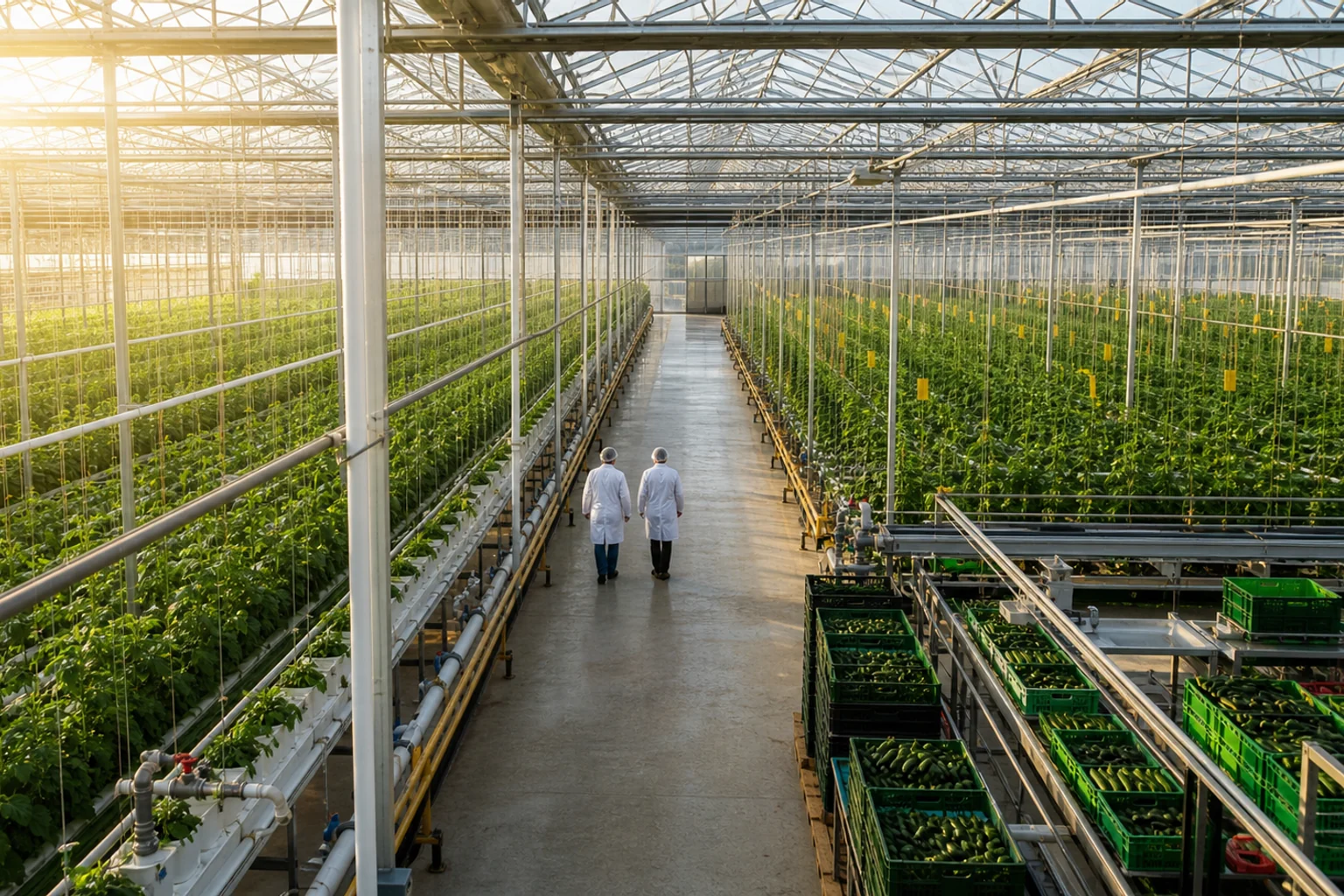
If you are planning to develop a greenhouse on one hectare of land, one of the first questions is: How much does a one-hectare greenhouse cost, and how much income and profit can it realistically generate?
One hectare equals 10,000 square meters, but greenhouse economics are not determined by area alone. Structure type, crop selection, cultivation system, climate, equipment, energy consumption, automation, production performance, and market conditions can significantly affect the final result.
This guide explains the construction cost, working capital, operating expenses, revenue, profit, and payback period of a one-hectare greenhouse.
What Is the Actual Growing Area of a One-Hectare Greenhouse?
One hectare equals 10,000 square meters, but the entire area is not necessarily used for crop production.
Part of the site may be allocated to:
- Access paths
- Water tanks
- Utility and control rooms
- Storage areas
- Packing facilities
- Loading areas
- Structural clearances
- Vehicle and machinery access
Production and revenue calculations should therefore be based on the actual productive growing area, not automatically on the full 10,000 square meters.
What Does the Cost of a One-Hectare Greenhouse Include?
Sadra estimate for 10,000 m² of actual greenhouse floor area: a soil-based greenhouse with minimum equipment is approximately 36–48 billion tomans, and a hydroponic greenhouse approximately 48–84 billion tomans. These are area-based construction estimates, not firm quotations or all-inclusive totals for land, infrastructure and a growing cycle. If a one-hectare site accommodates less than 10,000 m² of structure, use the actual greenhouse floor area.
| Cost item | Unit-price basis | Amount for 10,000 m² of greenhouse floor area |
|---|---|---|
| Soil-based, minimum equipment | 3.6–4.8 million tomans per m² of floor area | 36–48 billion tomans |
| Hydroponic | 4.8–8.4 million tomans per m² of floor area | 48–84 billion tomans |
| Structure only | 2–3 million tomans per m² of floor area | 20–30 billion tomans; already part of construction if included |
| Heating, different system options | 360,000–3.6 million tomans per m² of floor area | 3.6–36 billion tomans; system and capacity must be selected |
| Fan-and-pad cooling | Approximately 480,000 tomans per m² of floor area | Approximately 4.8 billion tomans |
| Greenhouse film, installation included | 350,000–450,000 tomans per m² of covering | Requires a measured roof-and-wall covering area |
| Polycarbonate covering | 600,000–1.2 million tomans per m² of covering | Covering quantity, installation and fittings must be specified |
Price basis: 13 October 2026. All amounts are in Iranian tomans, not rials.
How to use the table: an overall range does not replace an itemized scope. Do not add structure, covering, heating or cooling again if they are already included in the construction price. The heating range covers different systems and capacities; its upper end is not automatically compatible with the lowest total construction budget. Film prices already include installation. Covering area is not the same as land area. Land, storage reservoirs, worker buildings, utility connections, fencing, excluded transport and taxes, and working capital require separate scope checks.
See the greenhouse construction cost guide for comparisons across sizes and equipment scopes. This article focuses on one-hectare projects and the relationship between initial investment and operations.
Request a one-hectare greenhouse estimate +98 912 828 0308
The cost of a one-hectare greenhouse is not limited to the steel structure. A realistic investment calculation must include several technical and operational components.
Land and Site Preparation
- Land leveling
- Excavation or filling
- Drainage
- Fencing
- Internal roads
- Vehicle access
- Water, electricity, and fuel infrastructure
If the land is purchased or leased, the purchase price, rent, or deposit should also be included in the financial model.
Greenhouse Structure and Covering
Structural cost depends on factors such as:
- Greenhouse type
- Structure height
- Bay width
- Quantity and quality of steel
- Connection system
- Required wind and snow resistance
- Covering material
- Number of doors and vents
- Transportation and installation
Two one-hectare greenhouses can therefore have substantially different construction costs. Comparing projects only by price per square meter is not sufficient.
Heating, Cooling, and Ventilation
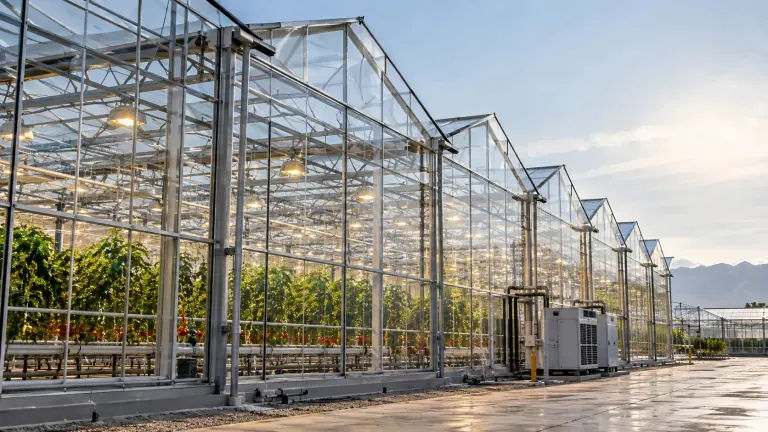
The heating-equipment guidance is 360,000–3.6 million tomans per m² of greenhouse floor area, or 3.6–36 billion tomans when multiplied by 10,000 m². Fan-and-pad cooling is approximately 480,000 tomans per m², or approximately 4.8 billion tomans at the same scale. System type, capacity, furnace and burner specifications, fan size and motor, pad height and manufacturer, and installation scope must match the climate and overall budget. Fuel, electricity and servicing are separate operating expenses.
Price basis: 13 October 2026. All amounts are in Iranian tomans, not rials.
Depending on the climate and crop, the project may require:
- Fan-and-pad cooling
- Heating systems
- Roof and side ventilation
- Fogging systems
- Shade screens
- Thermal screens
- Humidity-control equipment
Irrigation and Fertigation
- Water tanks
- Pumps
- Filters
- Piping
- Drip irrigation
- Fertilizer injection systems
- EC and pH control
Electrical Systems and Automation
- Electrical panels
- Wiring
- Environmental sensors
- Controllers
- Vent motors
- Monitoring systems
- Greenhouse automation
- Backup power
Automation should match the crop, climate, investment budget, and operating capabilities. More equipment does not automatically result in higher profits.
Working Capital and Greenhouse Operating Costs
After construction is completed, the project still requires cash until the first crop is harvested and sold. This is known as working capital.
- Seeds or seedlings
- Fertilizers and nutrients
- Pest and disease management
- Labor
- Water
- Electricity and fuel
- Maintenance
- Packaging
- Transportation
- Marketing and sales expenses
Ignoring working capital can result in a project that appears profitable on paper but faces cash-flow problems during the first production cycle.
How Is the Investment Required for a One-Hectare Greenhouse Calculated?
A preliminary investment model can be expressed as:
Total Investment = Land and Site Preparation + Structure and Covering + Climate-Control Equipment + Irrigation and Fertigation + Electrical Systems and Automation + Installation and Commissioning + Working Capital
Record each item once. If using a bundled construction contract, do not add its included structure, covering, equipment or installation again; add only excluded costs and working capital.
How Is One-Hectare Greenhouse Income Calculated?
Greenhouse income depends on several factors:
- Crop type
- Actual productive growing area
- Yield per square meter
- Product quality
- Waste percentage
- Number of production cycles
- Harvest timing
- Actual selling price
- Target market
The basic formula is:
Sales Revenue = Marketable Production × Net Selling Price
Not all harvested products will necessarily be sold as first-grade produce. Waste, lower-quality grades, and rejected products must also be included in the calculation.
How Should the Selling Price Be Estimated?
Using the highest market price when forecasting greenhouse revenue can lead to unrealistic projections.
Actual selling prices can vary according to:
- Harvest season
- Market supply
- Product quality
- Packaging
- Customer type
- Domestic or export market
- Transportation costs
- Sales contracts
How Is One-Hectare Greenhouse Profit Calculated?
Revenue and profit are not the same. Operating expenses must be deducted from sales revenue.
Operating Profit = Sales Revenue − Operating Expenses
Two greenhouses with similar sales revenue can have very different profits because of differences in energy use, labor costs, crop losses, maintenance, or management.
Three Scenarios for Estimating Revenue and Profit
Instead of using one fixed forecast, prepare at least three scenarios.
Conservative Scenario
- Lower production
- Lower selling prices
- Higher energy costs
- Higher crop losses
- Delayed production
Base Scenario
The base scenario should use realistic regional data, achievable crop performance, and reasonable average selling prices.
Favorable Scenario
This scenario can assume stronger production, lower losses, and more consistent sales, while remaining realistic and achievable.
Which Crop Is Most Profitable for a One-Hectare Greenhouse?
There is no fixed most-profitable crop: the answer depends on the growing method, greenhouse type, location, and market. Among greenhouse vegetables, coloured bell pepper can be a useful option to assess, but its market and sales economics should be tested before the final choice.
There is no single crop that is the most profitable in every region and under every production system.
Common greenhouse crops include:
- Tomatoes
- Cucumbers
- Bell peppers
- Strawberries
- Leafy vegetables
- Specialty or export crops
Profitability should be evaluated by considering yield, selling price, production costs, losses, and market demand together.
Approximate Profit = Sales Revenue − Production Costs − Selling Costs − Losses
Before selecting a crop, determine:
- Who is the main buyer?
- Is the market domestic or export-oriented?
- When will the product reach the market?
- What is the normal price during that season?
- What quality and packaging are required?
- What alternative market is available if prices decline?
Soil-Based or Hydroponic Greenhouse: Which Is Better?
Soil-based cultivation requires attention to soil preparation, soil improvement, irrigation management, and soil-borne diseases.
Hydroponic production generally requires additional investment in growing substrates, nutrient solutions, tanks, pumps, and monitoring equipment.
Hydroponics can provide more precise control over water and plant nutrition, but it also requires greater technical knowledge and investment.
Hydroponic production does not automatically guarantee higher profits.
What Is the Payback Period of a One-Hectare Greenhouse?
Payback period depends on the initial investment and the net cash flow generated by the project.
Payback Period = Initial Investment ÷ Annual Net Cash Flow
This formula is useful for an initial estimate. Projects with seasonal income, loans, installments, or phased expansion should be evaluated using monthly cash-flow analysis.
There is therefore no universal payback period that applies to all one-hectare greenhouse projects.
What Factors Have the Greatest Impact on Greenhouse Profitability?
Production Yield
Even a small change in yield per square meter can create a significant financial difference across one hectare.
Product Quality
The percentage of first-grade marketable produce can be as important as total production volume.
Selling Price
Harvest timing, customer type, and target market directly affect the final selling price.
Energy Costs
In some climates, heating or cooling may represent a major part of annual operating expenses.
Management
Irrigation, nutrition, climate management, pest control, harvesting, and labor management directly affect yield and quality.
Market Access
High production without a reliable sales market can result in lower prices and increased waste.
Is a One-Hectare Greenhouse Profitable?
A one-hectare greenhouse can be economically viable, but project size alone does not guarantee profitability.
A stronger project generally has:
- Adequate and suitable water
- Reliable energy supply
- A crop selected according to market demand
- A structure designed for local climate conditions
- Equipment matched to actual requirements
- Sufficient working capital
- Professional production management
- A defined market before planting
Greenhouse permits before construction
Start by applying for a greenhouse establishment permit through Iran’s National Licensing Portal. Typical requirements include identity documents, a valid land deed or lease, proof of water supply, the greenhouse layout, and a technical or feasibility plan.
After document review and an Agricultural Jihad site inspection, the establishment permit is issued. Once construction is complete and approved, apply for the operating permit. Requirements depend on the location, project type, and land status, so check the current guide for the relevant permit with the National Licensing Portal and the county Agricultural Jihad office before spending.
What Information Is Required to Estimate the Cost?
- Project location
- Total land area
- Climate conditions
- Water availability and quality
- Electricity and fuel availability
- Target crop
- Cultivation method
- Target market
- Required equipment level
- Automation requirements
- Approximate budget
- Expected project schedule
With this information, a project-specific estimate can be prepared instead of relying on a generic price.
How should one-hectare quotations be compared?
Use the same actual floor area and obtain quantities, units and specifications: structural sections and manufacturer; covering area and product; irrigation tanks and pumps; furnace and burner; fan brand and motor; pads and water tank; circulation fans; and installation scope. Compare transport, taxes, exclusions, price validity, payment terms and delivery dates as well.
Request a one-hectare greenhouse estimate +98 912 828 0308
Frequently Asked Questions
How much does a one-hectare greenhouse cost?
For 10,000 m² of actual greenhouse floor area, Sadra’s indicative range is 36–48 billion tomans for soil-based production with minimum equipment and 48–84 billion tomans for hydroponics. These use unit rates of 3.6–4.8 and 4.8–8.4 million tomans per m² respectively. Check land, infrastructure, excluded contract items and growing-cycle expenses separately.
Price basis: 13 October 2026. All amounts are in Iranian tomans, not rials.
Does one hectare mean 10,000 square meters of productive growing area?
No. Part of the site may be required for access roads, utilities, tanks, storage, packing, and other service areas.
How much income can a one-hectare greenhouse generate?
Income depends on the crop, productive area, yield, product quality, waste, selling price, and target market.
Is hydroponic production more profitable?
Not necessarily. Hydroponics can provide greater control, but it also requires more equipment, investment, and technical expertise.
How many years does it take to recover the investment?
There is no fixed payback period. Initial investment, operating costs, crop performance, selling prices, and actual project cash flow determine the result.
Conclusion
The question “How much does a one-hectare greenhouse cost and earn?” cannot be answered using land area alone.
Initial investment includes site preparation, greenhouse structure, covering, climate-control systems, irrigation, electrical systems, automation, installation, commissioning, and working capital.
Revenue depends on the actual growing area, crop, marketable yield, product quality, selling price, and market access.
A more useful question is:
How much investment does this specific one-hectare greenhouse require, and how much revenue and profit can it realistically generate with this crop, in this location, with this equipment, and for this target market?
Sadra Greenhouse Group can review the project location, infrastructure, target crop, and investment objectives to identify the main technical requirements and cost components of the project.
Greenhouse cost, profit and investment
Specialist guide: one-hectare scale
This is a scale-specific view of greenhouse economics, not a replacement for the main cost guide or a definitive estimate.
Was this article helpful?
Comments and questions
Join the conversation without an account. Names are entered by visitors; only verified staff carry the administrator badge.
Loading…