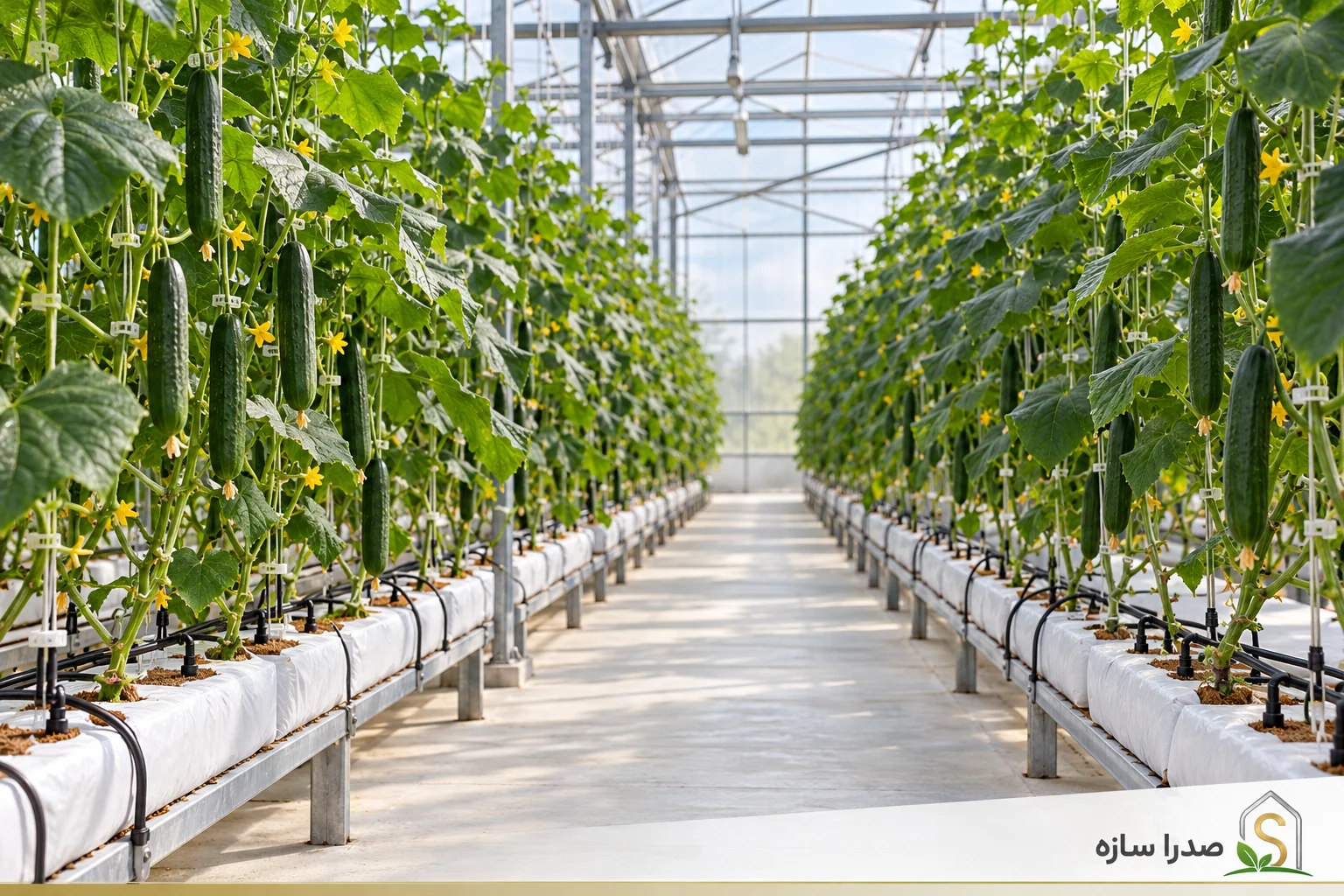
A hydroponic greenhouse grows crops without agricultural soil, supplying plant nutrients through a nutrient solution. Roots may grow in a substrate such as coir and perlite, or have access to flowing or aerated solution. The appropriate system depends on the crop, source water, climate, equipment and management capability. A modern greenhouse structure alone does not make the growing method hydroponic.
- Before starting: assess water, crops, buyers and site infrastructure.
- Before choosing a system: understand where roots grow and where the solution goes.
- Before choosing a crop: consider production requirements alongside market access.
- Before comparing prices: separate the structure, growing system, environmental equipment and infrastructure.
This guide supports commercial greenhouse planning. It explains systems, soil comparisons, equipment, cucumber and strawberry cultivation and routine operation. Final specifications require a crop specialist and reliable information about the actual site.
How do plants grow without soil?
Plants need water, nutrients, oxygen around their roots and suitable physical support. Soil is one way to provide these conditions. Hydroponics distributes those functions between a nutrient solution, a substrate or plant holder, and the irrigation system. Growing without soil does not remove the need for fertiliser, maintenance or disease management.
Nutrients dissolve in water and reach the root zone. Soil-grown roots also absorb nutrients from the surrounding solution; the important difference is how that environment is prepared and managed. Coir, perlite and mineral wool can support plants and influence the water–air balance. Their properties differ, so they should not all be treated as completely inert.
In some systems, cups, rafts or holders support the crop while more of the root system directly accesses the solution. Roots still need adequate oxygen. A full water tank does not prove that root conditions are suitable: solution temperature, movement and aeration also matter.
Where does the solution go? Open and recirculating systems
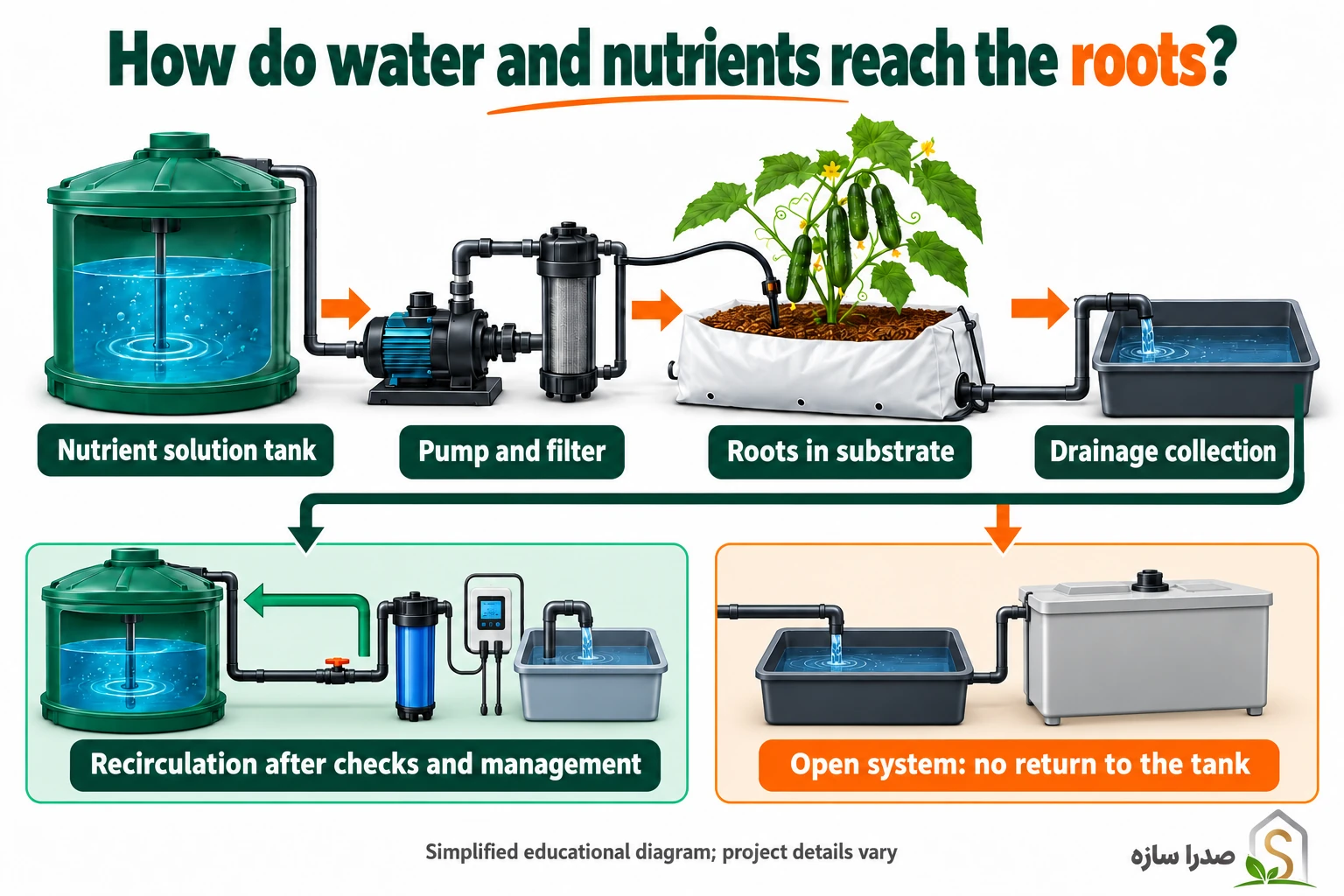
The process usually starts with incoming water and solution preparation, continues through delivery to the roots, and ends with management of excess solution. The exact equipment arrangement varies. A simple flow diagram helps the client understand the purpose of each component.
- Incoming water: assess supply and quality, selecting treatment where the analysis demonstrates a need.
- Nutrient solution: match fertiliser and source water to the feeding programme. Concentrated stock solution is different from the solution delivered to roots.
- Distribution: pumps, filtration, pipes and emitters or channels deliver the solution.
- Root zone: roots receive water and nutrients in a substrate or liquid-based system.
- Drainage: collect excess solution and define its destination in the design.
In an open or non-recirculating system, drainage does not return to the nutrient tank for that cultivation loop. Water use, fertiliser losses and permitted drainage handling still require management. Non-recirculation does not eliminate root disease.
In a recirculating system, collected solution is reused following appropriate quality management, nutrient adjustment and hygiene measures. This can reduce resource use, but an ordinary particle filter does not remove every pathogen or unwanted dissolved salt. Treatment and monitoring must suit the water and crop.
How does hydroponics compare with soil and conventional greenhouses?
Soil describes the cultivation medium; traditional and modern usually describe aspects of technology and management. A soil greenhouse can have precise irrigation and automated climate control. A fair comparison considers the same crop, season, climate and management standard.
| Topic | Soil cultivation | Hydroponic cultivation |
|---|---|---|
| Root environment | Agricultural soil and its specific properties | Selected substrate or direct access to nutrient solution |
| Nutrition | Based on soil and water tests and crop requirements | Based on source water, delivered solution, root-zone conditions and drainage |
| Response to errors | Soil properties can moderate some changes. | Depends on substrate and solution volume; some errors act quickly. |
| Water and fertiliser | Depend on irrigation and soil management. | Depend on system choice, drainage and recirculation. |
| Disease management | Soil, plants, water and environmental hygiene matter. | Substrate, plants, water and shared solution pathways matter. |
| Equipment and skills | Can range from basic to highly sophisticated. | Solution preparation and root-zone monitoring require a defined programme. |
Hydroponics is not a roof shape. A Gothic or multi-span frame can support soil-based or soilless production. Consult the greenhouse structure guide and greenhouse covering guide, then coordinate the growing system with the selected building.
How do the main hydroponic systems work?
Ask three questions: what supports the crop, how does solution reach its roots, and what happens to excess water? The following table is a starting point. Listed crops are examples of applications, not proof that a system is the best choice for every project.
| System | Root placement and delivery | Example application | Main check |
|---|---|---|---|
| NFT: nutrient film technique | Roots access a shallow flow of solution in channels. | Lettuce and some leafy greens | Flow uniformity, blocked paths and pump interruption |
| DWC: deep water culture | Holders support plants with roots accessing a solution bed. | Some leafy crops | Aeration, solution temperature and hygiene |
| Substrate with drip irrigation | Solution reaches bags, pots or slabs; drainage is collected. | Cucumbers, tomatoes, peppers and strawberries | Substrate properties, emitter uniformity and drainage |
| Ebb and flow | A tray or growing bed fills and drains on a designed cycle. | Some propagation and container crops | Uniform filling and drainage |
| Aeroponics | Solution is applied to roots suspended inside a chamber. | Specialised production or propagation | Nozzles, timing and failure protection |
| Wick or passive systems | Capillary action delivers solution to the medium. | Some small or educational applications | Water-delivery capacity matched to the plant |
NFT is not simply a pipe filled completely with water. In DWC, a larger water volume does not remove the oxygen requirement. A bag or container alone does not establish that a crop is hydroponic: the medium and feeding programme also need to be identified.
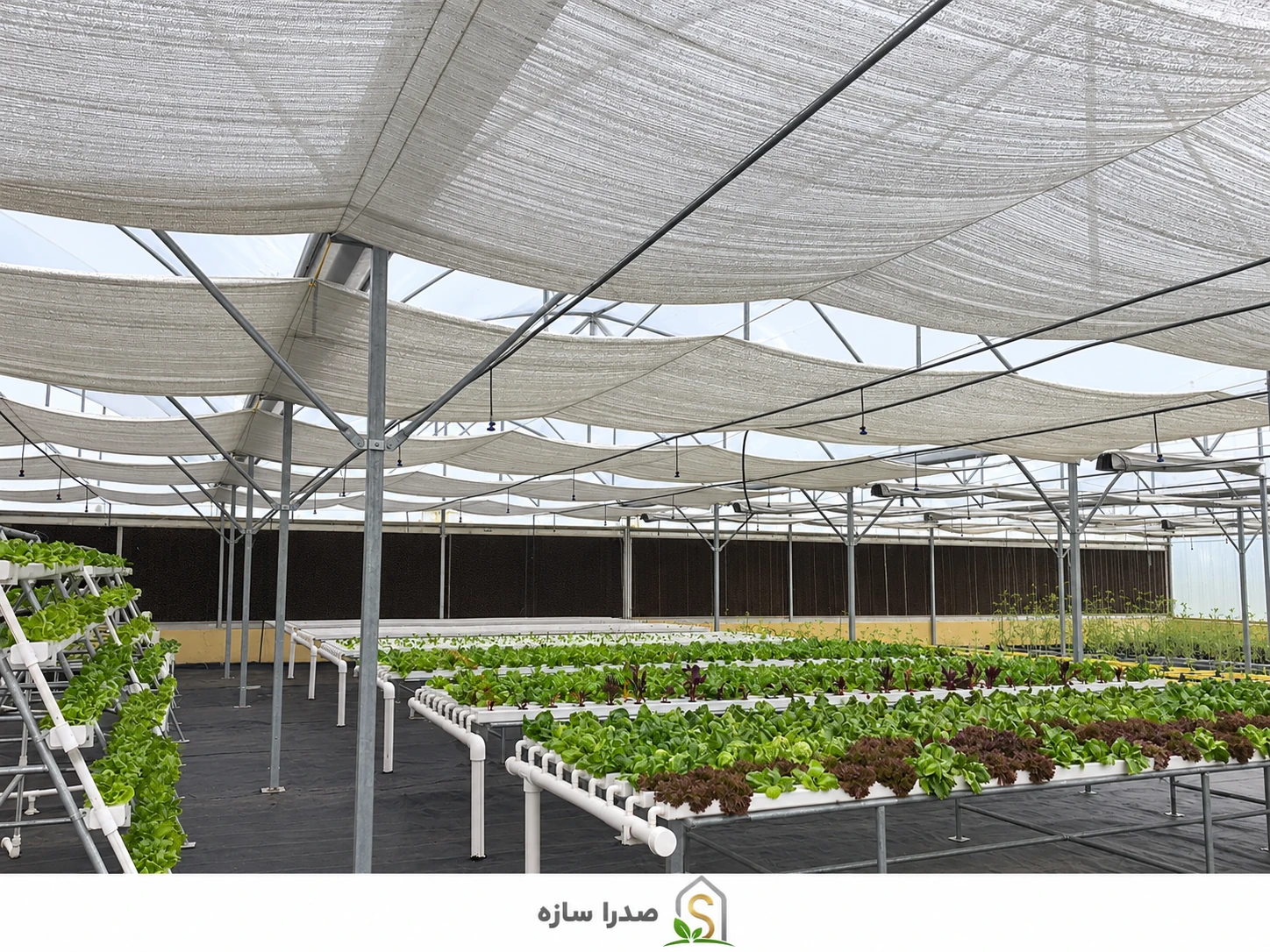
Vertical growing describes spatial arrangement and can be combined with different cultivation systems. More layers do not guarantee more marketable produce without checking light, shading, ventilation, access and structural loads. Short leafy crops and tall cucumber vines do not share one universal layout.
The overseas educational example below shows horizontal growing channels and an elevated arrangement. Layout needs to be coordinated with light, access and the crop's feeding system.
Which crop is best for a hydroponic greenhouse?
There is no single best crop for all growers. Establish buyers and their quality requirements, then assess climate, water, system requirements, skills and labour. Biological feasibility does not automatically make a crop commercially suitable for a particular site.
| Crop | System to consider | Key selection question |
|---|---|---|
| Lettuce and leafy greens | NFT, floating systems or suitable substrate production | How will buyers, leaf quality, food hygiene and root conditions be managed? |
| Basil and culinary herbs | Depends on species and harvest programme | What flavour, size, packaging and delivery schedule does the buyer require? |
| Tomato | Substrate with drip irrigation is a commonly considered option. | Are height, support, pruning, pollination and harvesting planned? |
| Cucumber | Substrate irrigation with suitable crop training | Can the business provide regular harvesting, crop management and uniform irrigation? |
| Bell pepper | A substrate programme suited to the cultivar | Have water, cropping period, grading and the target market been assessed? |
| Strawberry | Raised substrate gutters or another suitable production system | Are cultivar, planting material, temperature, pollination and postharvest needs coordinated? |
For each candidate crop, prepare the same comparison sheet: buyer, required quality, delivery season, facilities, labour, skills and main constraint. This is more informative than choosing a crop solely from a single day's selling price.
Review crop and system options for your site and water
Hydroponic cucumber: what needs to work together?
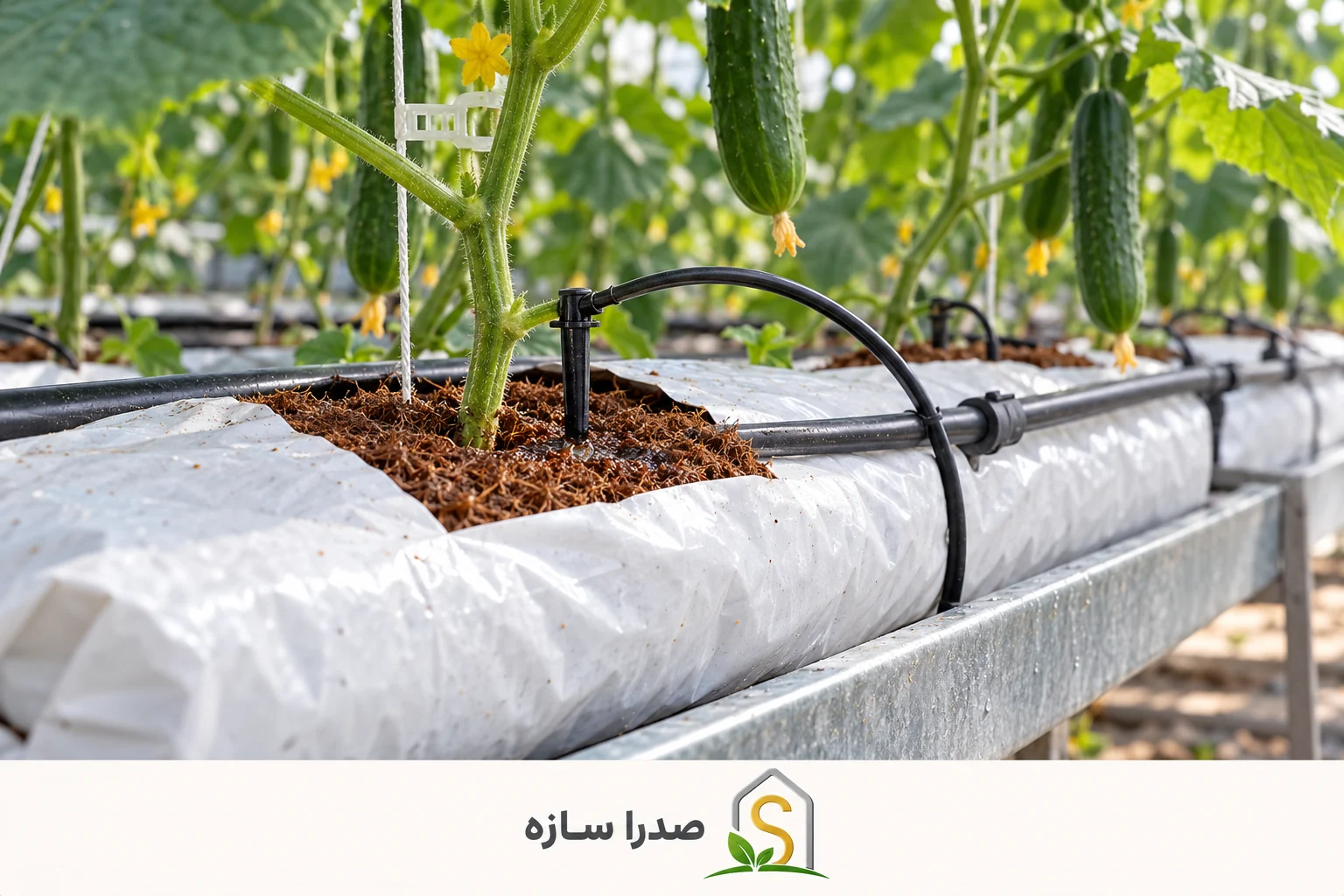
Cucumbers can be grown hydroponically, but cultivar, climate, root conditions and crop management affect the result. In substrate systems, emitters supply solution to the medium and excess solution drains away. The medium must retain suitable moisture while maintaining access to air.
Before ordering, define the bags or containers, working aisles, crop-support system and drainage collection route. Crop and suspended-equipment loads require coordination with the structural designer; a hydroponic layout does not permit attachment to any roof member.
During operation, assess crop growth, leaf symptoms, emitter delivery and substrate moisture together. Wilting can have several causes. Automatically adding water or fertiliser without investigating the cause is not a reliable response. Pruning and training should also match the cultivar and production system.
Hydroponic strawberry: more than installing a gutter
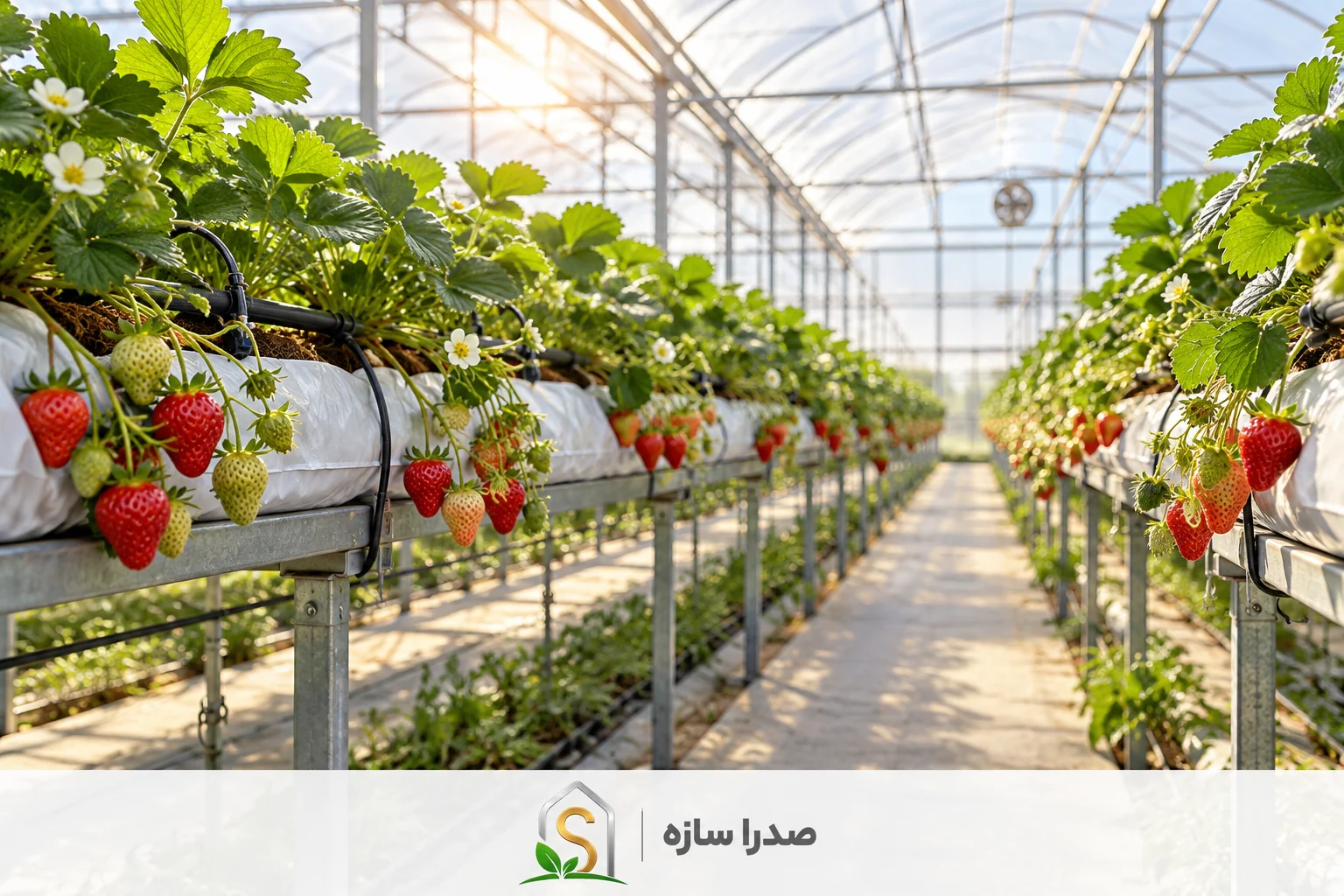
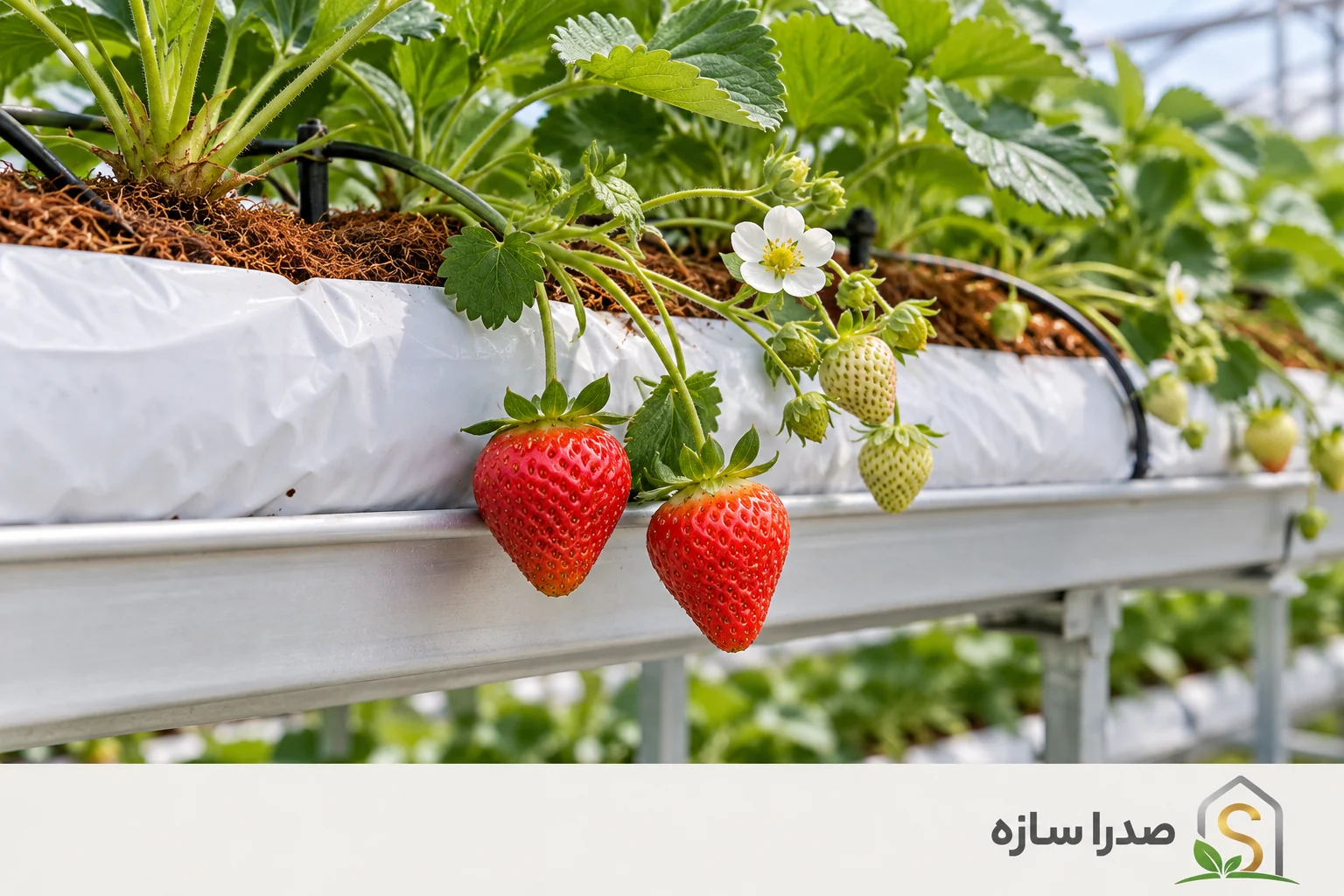
Strawberries can be grown in substrate on elevated gutters. An appropriate working height can improve access, but water, cultivar, plant quality, crown placement, root conditions and flowering requirements remain important. Do not copy planting density from another project without checking light and access.
Coordinate the gutter with substrate support, drainage and harvesting. Managing moisture around the crown is different from supplying water to roots. Plant positioning, drainage and irrigation must suit the substrate and the crop specialist's programme.
Include harvesting, internal transport, packaging and product storage in the initial plan. A propagation experiment cannot be translated directly into commercial fruit yield. Even within the same species, cultivar and production objective can change requirements.
Hydroponic greenhouse equipment and its purpose
The equipment schedule follows the cultivation method and site information. Some functions are common, others are system-specific, and some equipment is conditional. Reverse osmosis, supplemental lighting and solution cooling should not automatically be specified for every project.
| Equipment or function | Purpose | Selection check |
|---|---|---|
| Water and solution tanks | Storage, preparation or collection | Compatible materials, cleaning access, light exclusion and separation of functions |
| Pumps, filters and distribution | Deliver solution under the required conditions | Flow, pressure, materials, uniformity and network losses |
| Fertiliser injection | Controlled nutrient addition | Feeding programme, dosing accuracy and independent verification |
| Channels, beds, containers or gutters | Support crops and direct solution | System choice, cleaning and harvest access |
| EC and pH instruments | Monitor solution properties | Calibration, sampling location and reference checks |
| Aeration and oxygen monitoring | Manage oxygen where required | Tank and system requirements; water presence is not sufficient |
| Water treatment | Correct identified water-quality issues | Laboratory results, waste streams and maintenance |
| Heating, cooling and ventilation | Manage the crop environment | Climate, season, structure and crop |
| Alarms and backup provisions | Reduce the consequences of failure | Response procedure, responsibility and practical testing |
See hydroponic growing beds for plant-support design and the smart irrigation guide for delivery considerations. A larger rated pump is not automatically a better choice without checking the network.
EC and pH explained: what do the readings tell you?
Electrical conductivity, or EC, provides information about the dissolved ions conducting electricity in the solution. It does not separately identify each nutrient. Water samples with the same EC can have different compositions, so an EC reading does not replace laboratory analysis.
Keep the units consistent: 1 mS/cm equals 1 dS/m. A reading of 2,000 µS/cm is equivalent to 2 mS/cm. This is a unit-conversion example, not a feeding target for a particular crop.
pH describes acidity or alkalinity on the pH scale and affects nutrient availability. Water alkalinity is a different property associated with resistance to pH change. Set points and corrective actions depend on water, crop, growth stage and the nutrition programme; one universal target is inappropriate.
Label readings from the tank, delivered solution and drainage separately. Differences provide clues, not a complete diagnosis or an automatic instruction to add water or fertiliser. Instrument condition, measurement temperature, sampling time, irrigation volume and substrate conditions also matter.
Some concentrated fertiliser combinations can precipitate. Separation of incompatible stock solutions and the mixing procedure must follow a specialist's programme. A general article is not a project-specific nutrient recipe or a procedure for handling acids and concentrates.
Advantages and disadvantages, with their conditions
Hydroponics offers opportunities for closer root-zone management. Resource savings and more consistent production depend on design, water, crops and operation. Removing agricultural soil does not eliminate pests, disease, nutrition errors or food-hygiene requirements.
| Opportunity or constraint | Practical condition or consequence |
|---|---|
| More direct nutrition management | Requires suitable water, a feeding programme, accurate measurements and trained staff. |
| Possible solution recovery | Depends on composition, hygiene and drainage management; no universal saving percentage applies. |
| Less dependence on local soil | Suitable water, infrastructure and manageable environmental conditions remain necessary. |
| Equipment investment and complexity | Plan purchase, maintenance, spares and training. |
| Sensitivity to interruption | Roots, substrate, temperature and system design affect the response window. |
| Shared solution paths | Can spread introduced contamination, making hygiene important. |
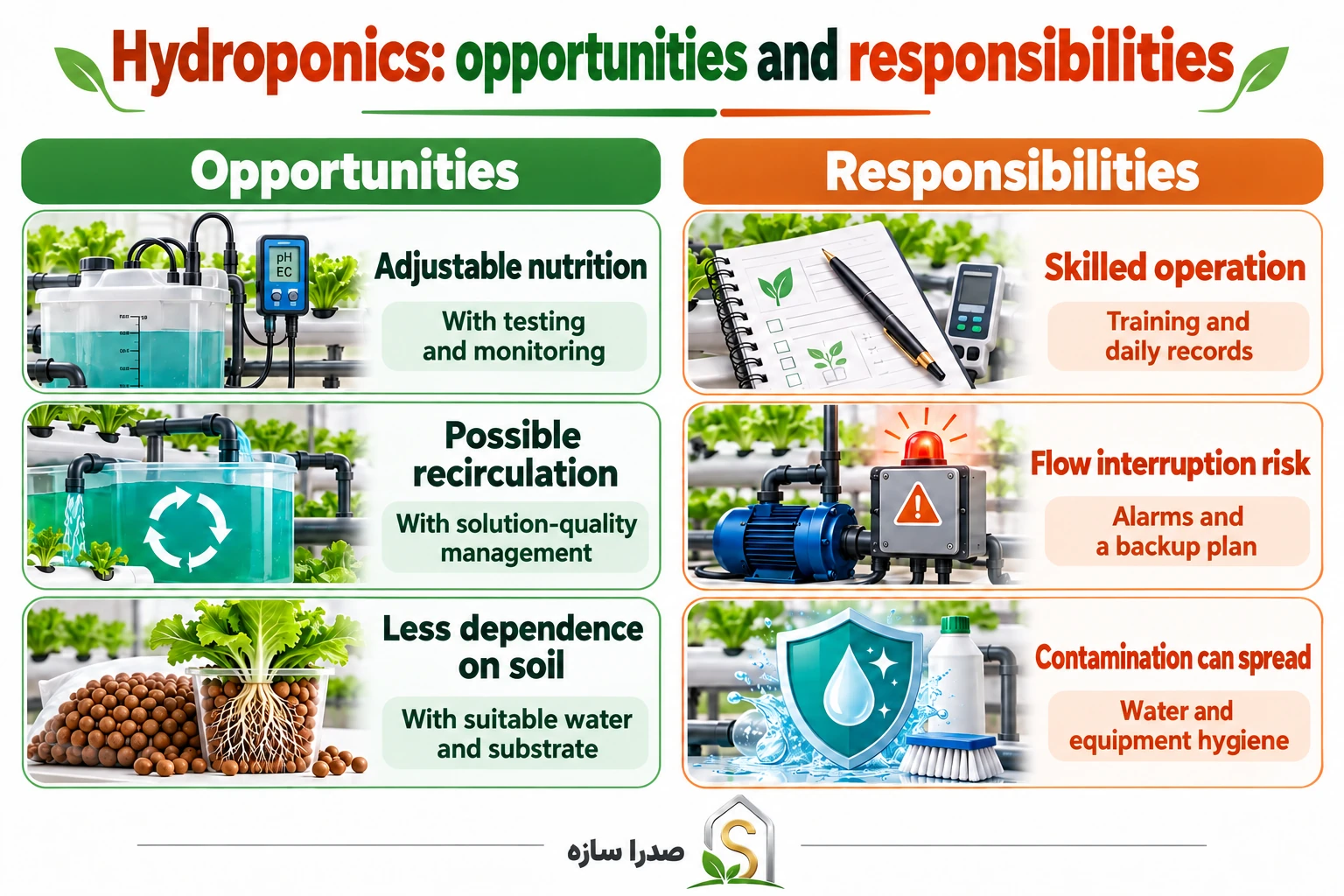
Compare systems using similar crops, seasons, equipment levels and marketable output. Neither higher yield nor healthier produce follows from the method's name alone. Coordinate root-zone management with greenhouse climate control.
Review water, equipment and implementation constraints
What does routine operation involve?
Operators need to examine the crop, solution and equipment together. Define monitoring frequency, sampling points and action thresholds for the project. Consistent records help reveal changes before they affect a large area.
| Check | Record |
|---|---|
| Tank and delivery | Solution level, leaks, pump operation, filters and outlets |
| Solution and substrate | EC and pH with units and sampling point, temperature and drainage condition |
| Crop | Growth, wilting, spots, colour changes, flowers, fruit and visible roots |
| Environment and operations | Temperature, humidity, harvesting, cleaning and setting changes |
| Unusual event | Start time, affected area, actions taken and responsible person |
When delivery stops, follow the operating procedure to check power, pump, tank level and blockages. There is no shared safe period of minutes or days for every system. A backup pump or generator needs practical testing and an assigned response procedure.
Brown roots, leaf-edge damage and reduced growth can have several causes. A photograph and an EC reading cannot confirm a specific disease or deficiency. Changing several factors without investigation can obscure the cause. Provide the crop specialist with recorded observations and measurements.
An Iranian example: lettuce in a Sadra project
The Hesami project page describes a 16,000 m² complex containing hydroponic lettuce and soil-grown cucumbers. These are distinct growing methods within one project. The following image shows the lettuce section.
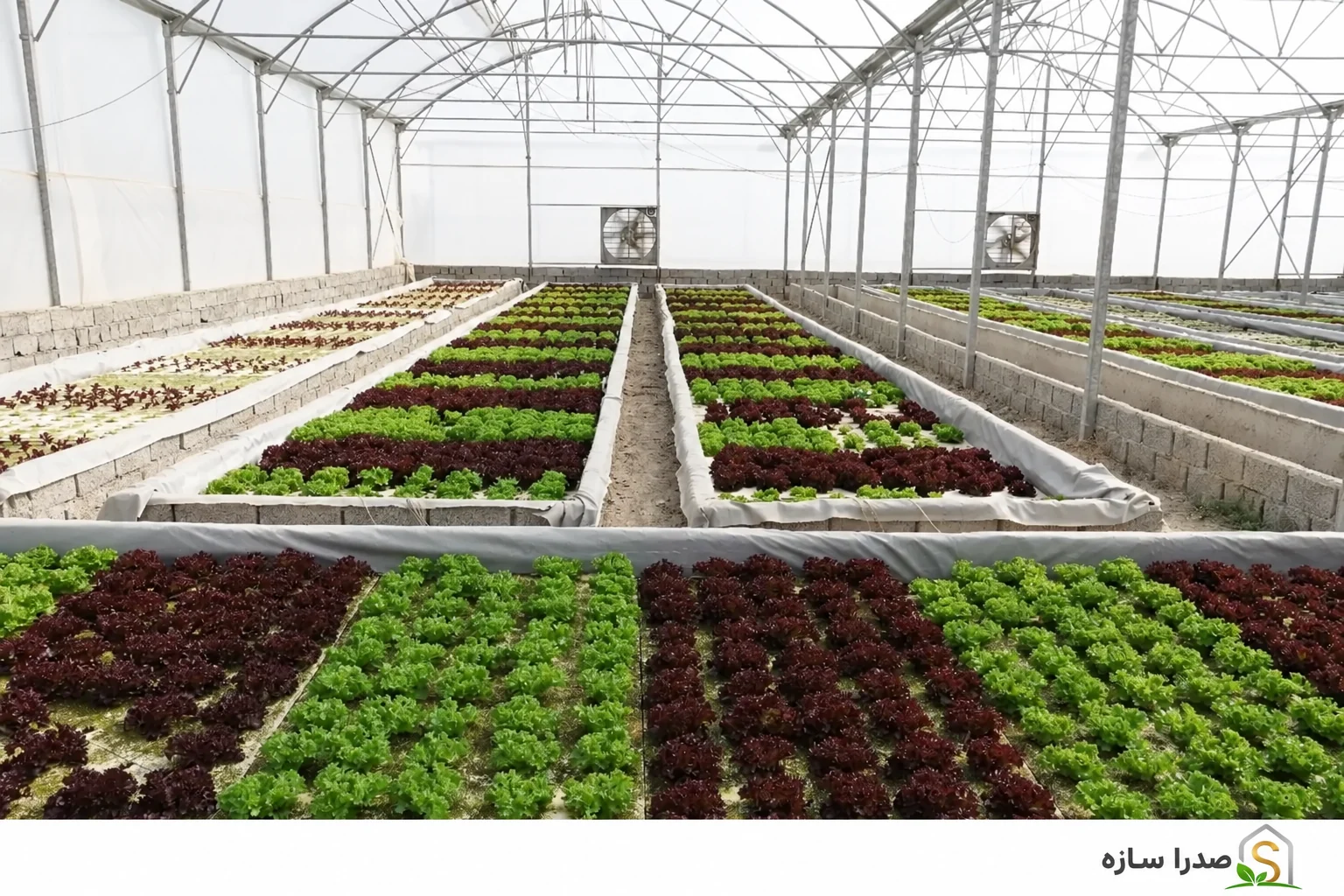
The Karaj hydroponic tomato project also provides recorded project information. Compare the crop, site conditions and contractual scope with your proposal. A photograph or project name does not establish identical performance in another location.
What information is needed before construction and cost estimation?
Prepare the basic site information and define the scope. Identify location and climate, land dimensions, built area, water analysis and supply, energy, crop, buyers and operational capability. Then compare proposals on equivalent technical and supply terms.
- Initial investment: structure, covering, growing system, nutrition and delivery, environmental equipment, infrastructure, installation and commissioning.
- Operating costs: plants, fertiliser, substrates and consumables, energy, labour, servicing, calibration and drainage management.
- Conditional equipment: treatment, disinfection, supplemental light, solution cooling and power backup selected through assessment.
- Handover: as-built drawings, training, maintenance programme, warranty scope and acceptance checks.
This guide does not provide a firm quotation or projected income. Refer to the greenhouse construction cost guide for the wider cost framework, then specify the hydroponic system and equipment. Roof-and-wall area, floor area, net planted area and plant numbers are different estimating bases.
Unsuitable water, unplanned outages or lack of trained staff may require changes to the proposal or comparison with other options. See the greenhouse design and construction guide for the broader decision sequence.
Frequently asked questions
Is hydroponics the same as a smart greenhouse?
No. Hydroponics describes root-zone cultivation and feeding; smart control describes monitoring and automation. Soil cultivation can also be automated. See our smart greenhouse guide.
Must all roots be submerged in water?
No. Some systems supply solution through emitters to roots in a substrate. Liquid systems use other arrangements for plant support and root oxygenation.
Is cucumber or strawberry better for a new project?
The answer depends on water, climate, cultivar, buyers and management capacity. Crop support, harvesting, environment and equipment requirements should be evaluated separately.
Does every greenhouse need water treatment?
Water analysis and crop requirements determine treatment needs. Particle filters and dissolved-salt treatment perform different jobs; neither is a universal answer to every water issue.
Is hydroponic production free of pests and disease?
No. Plants, water, people, equipment and the surrounding environment can introduce contamination. Hygiene and monitoring remain necessary.
What should I send for an initial technical proposal?
Provide the location and site plan, built area, water analysis, water and energy supply, crop options, target market and expansion plans. The proposal should identify specifications, exclusions, installation and training.
Request a hydroponic greenhouse and equipment review
Technical sources
- Oklahoma State University: Hydroponics; system classifications and open/closed operation.
- University of Minnesota: Small-scale hydroponics; channels, solution management, monitoring and hygiene.
- Penn State Extension: Hydroponics Systems; nutrition, preparation and fertiliser compatibility.
- Penn State Extension: greenhouse water-quality and plant-disease guidance.
- Oklahoma State University: EC/pH and hydroponic crop-management guidance.
- Cornell University: controlled-environment agriculture resources and strawberry propagation research.
- Sadra project pages: recorded information for Hesami and the Karaj tomato greenhouse.
Was this article helpful?
Comments and questions
Join the conversation without an account. Names are entered by visitors; only verified staff carry the administrator badge.
Loading…